

Quick Answer
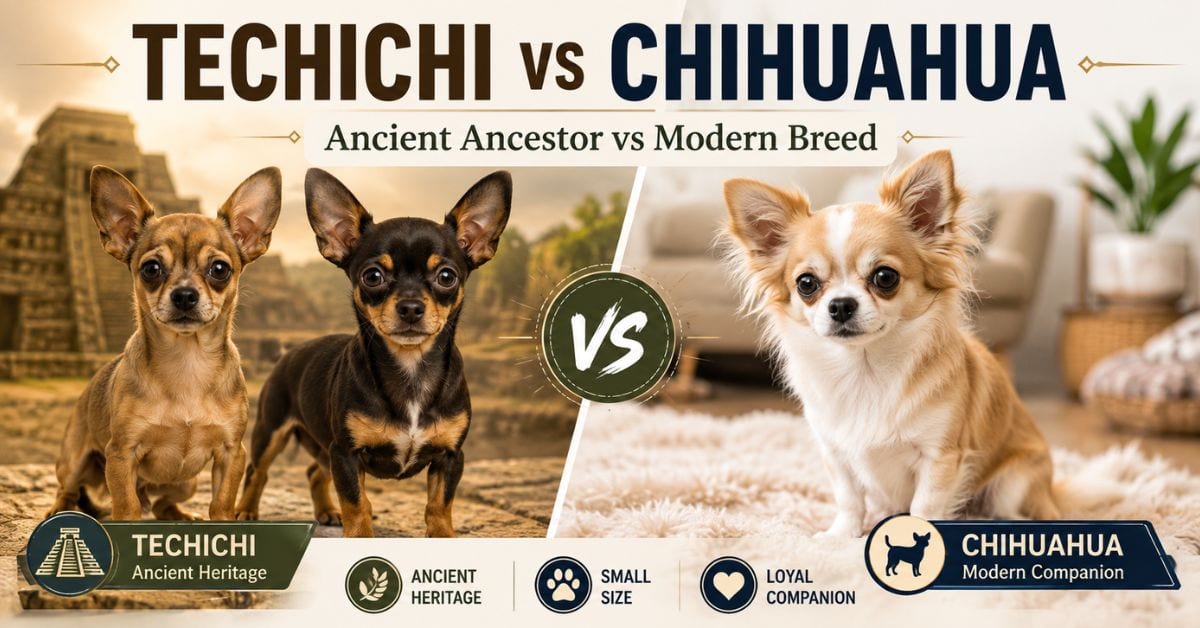
The Techichi and Chihuahua are not the same dog. The Techichi was an ancient small dog associated with the Toltec civilization and is traditionally regarded as an ancestor of the modern Chihuahua.
The Chihuahua is a recognized modern breed with a defined standard, while the Techichi is extinct and known mainly through historical records, artwork, and archaeological evidence.
Author Box
Author: Gulnaz Malik
Role: Publisher & Pet Care Expert
Experience: 5+ Years in Dog Care & Dog Grooming
Content Review: Veterinary-reviewed content approach based on trusted canine care resources and practical pet care experience.
Introduction:
The Techichi vs Chihuahua comparison is really a story about how an ancient Mexican dog became connected to one of the world’s best-known toy breeds.
If you have ever wondered whether the Chihuahua is simply the modern version of the Techichi, the answer needs a little more explanation.
The Techichi was an ancient dog associated with the Toltec civilization in Mexico. Historical and archaeological evidence connects this small companion dog with ancient Mesoamerican cultures.
Modern Chihuahuas are also strongly associated with Mexico, but the exact genetic relationship between the named Techichi and today’s Chihuahua remains difficult to prove because no confirmed Techichi specimen has been genetically sequenced.
That distinction matters because many websites present uncertain historical claims as established facts.
You may see exact Techichi weights, coat descriptions, or claims about its behavior stated with complete confidence.
In reality, much of the Techichi’s appearance and behavior must be reconstructed from old artwork, written accounts, and archaeological evidence.
The modern Chihuahua is much easier to define. Major kennel organizations recognize it as a distinct breed with a formal standard.
The American Kennel Club describes the Chihuahua as a compact dog weighing no more than 6 pounds under its breed standard.
This guide separates documented facts from traditional theories so you can understand the Techichi vs Chihuahua difference without relying on exaggerated claims.
Techichi vs Chihuahua: History and Ancient Origins
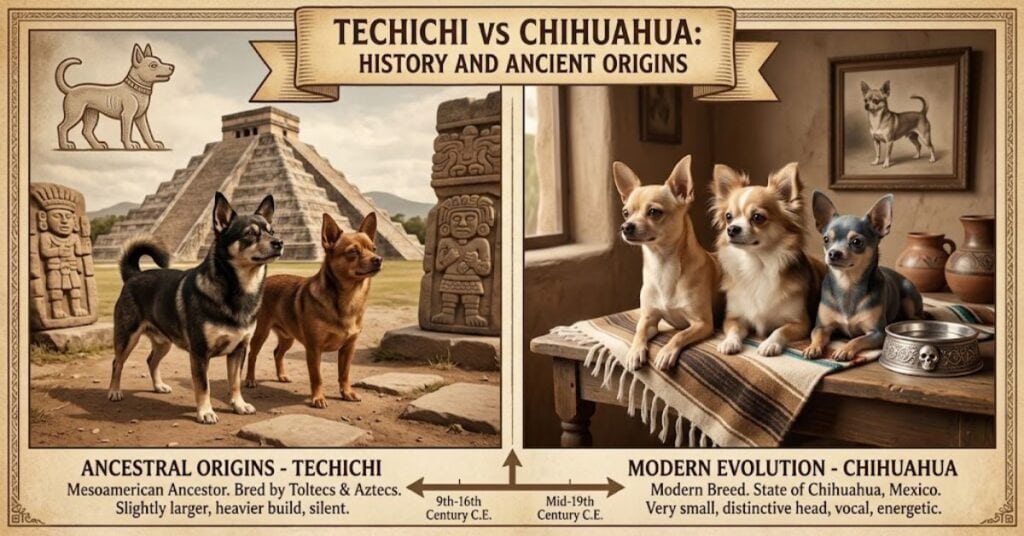
The biggest difference between the Techichi and the Chihuahua is their place in history. The Techichi belongs to the ancient world, while the Chihuahua is a living, standardized breed.
The Techichi is traditionally associated with the Toltecs, a Mesoamerican civilization that flourished in what is now Mexico.
The American Kennel Club identifies the Techichi as a precursor to the Chihuahua and notes that the Toltecs had a small dog that was part of the Chihuahua’s early history.
The Fédération Cynologique Internationale also discusses the Techichi in the historical background of the Chihuahua.
Its official Chihuahua standard says representations of a toy dog called the Techichi were found in Tula and that these representations were very similar to the present-day Chihuahua.
However, it is important to use careful language.
The Techichi was not simply a Chihuahua with an ancient name. It existed in a very different historical environment and was not managed according to a modern breed standard.
The Chihuahua emerged as a recognizable modern breed much later. Dogs resembling today’s Chihuahua became associated with the Mexican state of Chihuahua, and the breed eventually spread internationally.
The AKC recognized the Chihuahua in 1904, making it one of the organization’s early recognized breeds.
There is also evidence supporting a deeper connection between modern Chihuahuas and pre-Columbian Mexican dogs.
The important point is that genetic evidence can support ancient Mexican ancestry without proving that a particular dog was genetically identical to the historical Techichi.
What the historical evidence tells us
- The Techichi was an ancient Mexican dog associated with the Toltec period.
- Ancient representations of the Techichi resemble Chihuahua-like dogs.
- The Chihuahua has deep historical connections to Mexico.
- Modern Chihuahua ancestry includes pre-Columbian Mexican dog lineage.
- The exact genetic identity of the Techichi remains uncertain.
- The Chihuahua became a formal modern breed with a written breed standard.
This is a simple observation: the Techichi is traditionally considered an important ancestor or predecessor of the Chihuahua, but the two should not be treated as identical breeds.
The history is fascinating because it shows how dogs have changed over centuries as human societies, breeding practices, and cultural roles have changed.
Techichi vs Chihuahua: Size, Body, and Appearance
When people search for Techichi vs Chihuahua, physical appearance is usually one of their first questions. The modern Chihuahua has a clear physical standard. The AKC describes it as a graceful, alert, compact dog with a weight limit of 6 pounds in the breed standard.
It has large erect ears, expressive eyes, and the familiar rounded “apple dome” skull.The Techichi is much harder to describe precisely.
There are no living Techichis that can be measured and examined like modern dogs. Instead, researchers and historians rely on archaeological figures, artwork, historical descriptions, and later accounts.
Because of this, precise claims about the Techichi’s exact height or weight should be treated cautiously.
The modern Chihuahua has also developed recognizable physical characteristics through selective breeding.
| Feature | Techichi | Modern Chihuahua |
| Status | Extinct historical dog | Living recognized breed |
| Historical setting | Ancient Mesoamerica | Modern Mexico and worldwide |
| Size | Believed to be small and sturdier; exact measurements uncertain | Breed standard: no more than 6 lb under AKC standard |
| Head | Historical representations resemble Chihuahua-like forms | Distinct rounded apple-domed skull in AKC standard |
| Ears | Ancient representations suggest prominent ears | Large, erect ears |
| Tail | Historical evidence is less standardized | Moderately long, carried high |
| Coat | The exact coat type is uncertain | Smooth coat and long coat varieties |
| Breed standard | None | Formal breed standards exist |
| Availability today | Extinct | Widely available companion breed |
The comparison shows why it is misleading to say that every modern Chihuahua feature existed unchanged in the Techichi.
The modern Chihuahua is the product of a long history of selection. Its tiny size, standardized appearance, and recognized coat varieties are characteristics of the modern breed.
The FCI standard describes the Chihuahua as a compact companion dog with an apple-shaped skull, a moderately long, high-carried tail, and an alert, lively, courageous temperament
Techichi vs Chihuahua: Temperament and Behavior
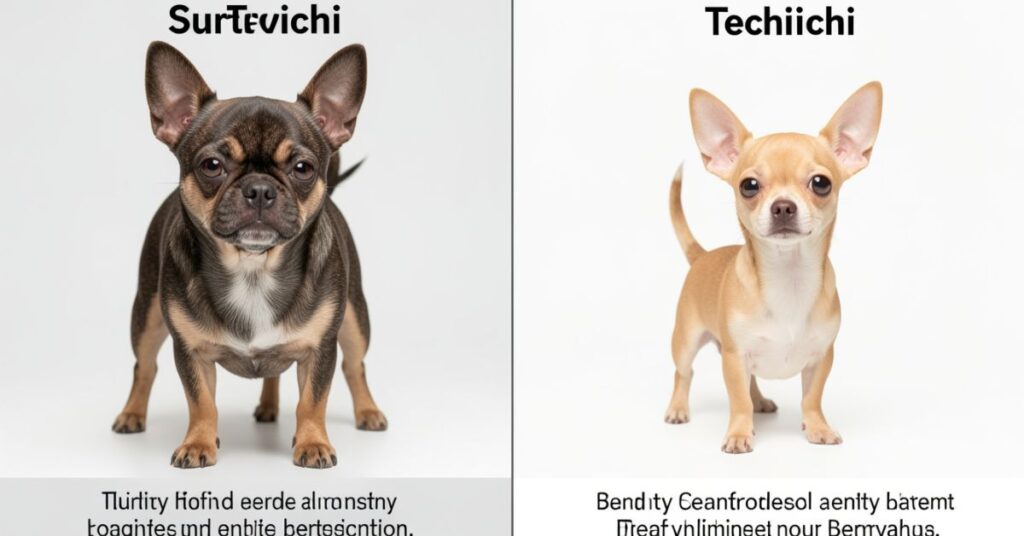
Another interesting part of the Techichi vs Chihuahua discussion is temperament. Unfortunately, we cannot observe a living Techichi today. That means claims about its personality should be treated more carefully than descriptions of modern Chihuahuas.
Historical sources connect the Techichi with human companionship and ancient Mexican cultures. Some traditions also associate these dogs with religious or spiritual practices. However, modern descriptions of the Techichi’s personality can sometimes go far beyond what historical evidence can reliably prove.
The Chihuahua, by contrast, can be studied directly. The FCI describes the Chihuahua as quick, alert, lively, and courageous. The AKC similarly describes the breed as alert and lively, with a strong personality despite its tiny body.
A Chihuahua can be affectionate with its family but may also become protective, vocal, suspicious of strangers, or reactive around unfamiliar dogs. These behaviors do not mean every Chihuahua behaves the same way. Genetics, early socialization, training, environment, and individual personality all matter.
Because the Chihuahua is so small, owners sometimes accidentally reinforce unwanted behavior.
For example, an owner may pick up a Chihuahua every time it barks at another dog. The dog then learns that barking results in escape or attention. With consistent reward-based training, the owner can instead teach calm behavior.
A Chihuahua should not be treated like a toy simply because it is tiny. Daily mental stimulation matters. Short training sessions can teach useful behaviors such as:
- Sit
- Stay
- Come
- Leave it
- Quiet
- Loose-leash walking
- Calm handling
- Appropriate greetings
The Techichi’s temperament cannot be tested in the same way because the dog is extinct. Therefore, it is better to say that the Chihuahua retains some historical associations with a small Mexican companion dog while recognizing that modern behavior is shaped by generations of breeding and contemporary living conditions.
Techichi vs Chihuahua: Coat, Grooming, and Daily Care
The Techichi vs Chihuahua comparison becomes much easier when you focus on the dog you can actually care for today.
You cannot groom a living Techichi because the breed is extinct. Historical evidence suggests that Techichis may have had different coat characteristics, but exact details are not reliable enough to create a modern grooming schedule.
The Chihuahua has two recognized coat varieties: smooth and long. The AKC specifically recognizes both long- and smooth-coated Chihuahuas.
A smooth-coat Chihuahua generally needs less brushing. A long-coat Chihuahua requires more regular brushing, especially around areas where hair can tangle.
Good grooming is not just about appearance. It allows you to check the skin, ears, nails, paws, and coat regularly. Early detection can help you notice problems before they become more serious.
Simple Chihuahua grooming routine
- Brush: Several times a week for long coats; regular brushing for smooth coats.
- Nails: Check frequently and trim when they become too long.
- Ears: Inspect for wax, odor, redness, or irritation.
- Teeth: Brush regularly with dog-safe dental products.
- Paws: Check after walks for cuts, debris, or irritation.
- Bathing: Bathe when needed rather than excessively.
- Skin: Look for lumps, redness, parasites, or unusual hair loss.
Small dogs can also become uncomfortable if their nails grow too long. Long nails may change the way a dog walks and place extra pressure on the toes.
Dental care deserves special attention too. Toy breeds can develop dental crowding because their mouths are very small. Regular home dental care and veterinary dental examinations can help maintain oral health.
Your Chihuahua’s care routine should also reflect its coat type, age, activity level, and health.
For additional small-dog grooming context, you can read ChihuahuaNest’s guide on Shaved Pomeranian Puppy and Double-Coat Safety, although Pomeranians and Chihuahuas have different coat structures and should not be groomed identically.
The most important lesson from the Techichi vs Chihuahua comparison is that historical curiosity should not replace modern care standards. A Chihuahua living in your home needs routine grooming, dental care, nutrition, exercise, training, and veterinary attention.
Techichi vs Chihuahua: Health and Lifespan Considerations
Health is another area where the Techichi vs Chihuahua comparison needs careful interpretation.
There is no reliable modern health database for the extinct Techichi. We cannot accurately provide a Techichi lifespan or claim that it suffered from particular modern breed conditions.
The Chihuahua is different because veterinarians and breeders can monitor living dogs.
Chihuahuas are tiny, and their small bodies create some special management needs. Owners should pay attention to body weight, dental health, joint comfort, eye health, and general mobility.
Puppies also require careful feeding. Very young toy-breed puppies can be vulnerable to low blood sugar when they do not eat properly, especially during illness, stress, or inadequate feeding. Any puppy that becomes weak, unusually sleepy, shaky, or unresponsive needs prompt veterinary attention.
Adult Chihuahuas can also gain excess weight if owners give too many treats or measure portions inaccurately.
A useful way to monitor your dog is to focus on trends rather than one isolated observation.
Chihuahua health monitoring scale
Level 1 — Normal:
Normal appetite, energy, stool, breathing, and behavior.
Level 2 — Watch:
Minor changes such as slightly reduced appetite, occasional soft stool, or unusual scratching. Monitor closely.
Level 3 — Veterinary Discussion
Repeated vomiting, persistent diarrhea, ongoing coughing, unexplained weight changes, significant dental discomfort, or persistent behavior changes may require veterinary evaluation.
Level 4 — Urgent Veterinary Care
Difficulty breathing, collapse, severe weakness, repeated seizures, major trauma, or an inability to stand normally should be treated as urgent veterinary concerns.
Level 5 — Emergency:
Unresponsiveness, severe breathing difficulty, suspected poisoning, or other life-threatening symptoms require immediate veterinary attention.
This scale is a practical monitoring framework, not a medical diagnosis.
If your Chihuahua develops a sudden or severe symptom, do not attempt to diagnose it from an online article.
Nutrition is equally important. Select a complete and balanced food appropriate for your dog’s life stage and size. Portion control matters because even a small amount of excess food can represent a significant calorie increase for a tiny dog.
ChihuahuaNest has several dog nutrition resources that may help with broader food comparisons, including Kirkland Dog Food Review, Cesar Dog Food Review, and Taste of the Wild Dog Food Review.
These resources should supplement, not replace, advice from your veterinarian when your dog has a diagnosed medical condition.
Techichi vs Chihuahua: Training, Exercise, and Family Life
The modern Chihuahua may be tiny, but it still needs exercise and training. One common mistake is assuming a toy breed does not need physical activity.
A Chihuahua does not require the same exercise program as a large working dog, but regular movement helps support healthy weight, muscle tone, confidence, and mental stimulation.
Short walks can work well for many Chihuahuas. Indoor play can also provide activity when weather conditions are uncomfortable. Training should remain gentle and consistent.
Harsh punishment can increase fear and defensive behavior. Reward-based training gives the dog a clear reason to repeat desirable behaviors.Start with simple commands and reward the behavior you want.
For example, if your Chihuahua becomes nervous when visitors arrive, reward calm behavior before the dog becomes highly excited. Over time, the dog can learn that staying relaxed produces positive outcomes.
| Lifestyle Factor | Chihuahua | What Owners Should Consider |
| Apartment living | Often suitable | Daily walks and mental stimulation remain important |
| Small home | Usually manageable | Create a safe resting and play area |
| Children | Possible with supervision | Teach children safe handling |
| Other dogs | Depends on socialization | Avoid rough play with much larger dogs |
| Exercise | Moderate | Short walks and play sessions can work well |
| Training | Highly recommended | Use consistent reward-based methods |
| Cold weather | Needs protection | Small bodies can lose heat quickly |
| Hot weather | Needs careful management | Provide shade, water, and avoid excessive heat |
| Travel | Convenient size | Use a secure carrier or harness |
| Seniors | Often adaptable | Monitor mobility, dental health, and weight |
That is one of the most important lessons here: history explains where a breed may have come from, but responsible care must be based on the living animal in front of you.
Techichi vs Chihuahua: Common Myths and Mistakes
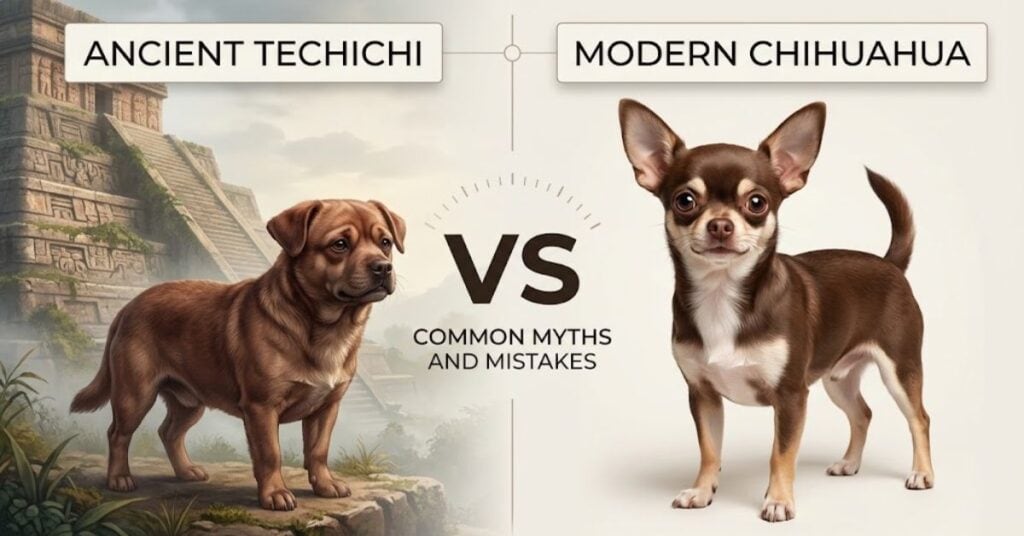
The internet contains many claims about the Techichi vs Chihuahua comparison. Some are reasonable interpretations, while others are presented as facts without enough evidence.
One common myth says the Techichi was exactly the same size as a modern Chihuahua. There is no good reason to assume that. Historical descriptions and modern interpretations generally place the Techichi as a sturdier ancient dog, while the Chihuahua has been selectively bred into a very small modern breed.
Another claim gives an exact Techichi weight. Precise numbers are difficult to defend because we do not have a living population or comprehensive skeletal measurements from confirmed Techichis.
A third mistake is treating the Chihuahua’s entire modern appearance as proof of direct inheritance from the Techichi.
Similarity can support a historical connection, but it does not prove that every physical feature came directly from one ancient breed.
The AKC describes the Techichi as the progenitor of the Chihuahua, while its historical material also discusses theories about additional influences. (American Kennel Club)
A responsible article should therefore distinguish between documented history, accepted breed tradition, and unresolved scientific questions.
Techichi vs Chihuahua: Do’s and Don’ts
Do:
- Treat the Techichi as an extinct historical dog.
- Recognize the Chihuahua as a modern breed.
- Use official breed standards for modern Chihuahua characteristics.
- Be cautious about exact Techichi measurements.
- Focus on evidence when discussing ancestry.
- Give modern Chihuahuas care based on current veterinary knowledge.
Don’t:
- Claim that Techichis and Chihuahuas are identical.
- Invent an exact Techichi lifespan.
- Present uncertain historical theories as proven genetics.
- Assume every Chihuahua behaves the same way.
- Ignore veterinary care because the breed is naturally small.
- Use historical descriptions to replace modern health guidance.
The FDA provides useful information for pet owners about animal food safety, recalls, and safe feeding practices, making it an appropriate authority to consult when evaluating current pet-food concerns. FDA Pet Food Safety Information
For modern breed information, the AKC’s Chihuahua resources and official standard are also useful references. AKC Chihuahua Breed Information
Finally, remember that a historical breed comparison should make you more informed, not more confident about unsupported claims.
Is the Chihuahua Really Descended From the Techichi?
The short answer is: the Techichi is traditionally regarded as an important predecessor or ancestor of the Chihuahua, but the exact genetic relationship has not been completely established.
This distinction is one of the most important facts in the entire Techichi vs Chihuahua discussion.
The historical connection is strong. The Techichi was associated with the Toltecs; ancient representations resemble Chihuahua-like dogs, and major canine organizations describe the Techichi as part of the Chihuahua’s history.
There is also evidence that modern Chihuahuas carry ancestry connected to pre-Columbian Mexican dogs. That strengthens the broader conclusion that the Chihuahua has deep indigenous Mexican roots. But there is a scientific limitation.
Researchers cannot simply compare the DNA of a living Chihuahua with a confirmed Techichi because no authenticated Techichi genome is currently available for direct comparison. Therefore, saying “the Chihuahua is genetically proven to be the Techichi” goes beyond the available evidence.
The Chihuahua is a modern Mexican breed with deep pre-Columbian ancestry, and the Techichi is traditionally identified as an important ancient predecessor in that history.
The modern Chihuahua also has its own documented breed development. The AKC recognized the Chihuahua in 1904, and the breed now has a formal standard defining important characteristics such as size, head shape, ears, proportions, and overall appearance.
This is why the two dogs should not be treated as competing choices.
You cannot choose a Techichi puppy today because the Techichi is extinct.
If you are looking for a living dog with historical connections to this ancient Mexican lineage, the Chihuahua is the relevant breed to learn about.
A simple way to remember the difference
Techichi = ancient, extinct, historical predecessor.
Chihuahua = modern, living, recognized companion breed.
That one distinction answers most questions about the comparison.
How to Choose a Chihuahua With the Techichi History in Mind
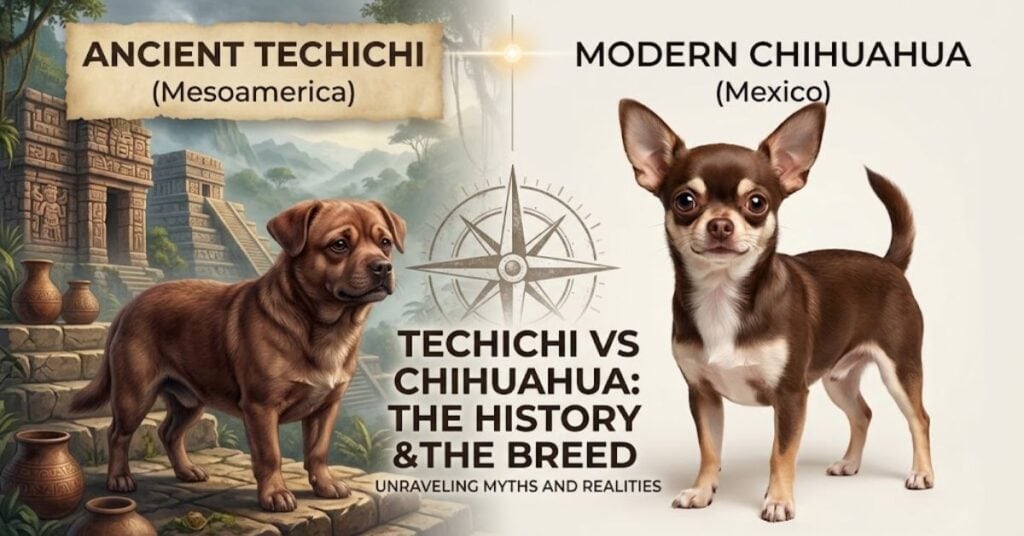
If your interest in the Techichi vs Chihuahua topic comes from wanting a Chihuahua, history is only the beginning.
A responsible choice starts with the individual dog’s health, temperament, breeder or rescue background, and living environment.
Avoid choosing a puppy only because it is extremely small. “Teacup” is a marketing term rather than a separate AKC-recognized Chihuahua variety. Extremely small puppies may have additional care challenges, and size alone should never be the main selection goal.
Instead, look for a puppy that appears active, alert, appropriately socialized, and healthy.
Ask about veterinary examinations and health history. A responsible breeder should be willing to discuss the parents, available health information, vaccination and deworming records, and how puppies are raised.
If adopting, ask the rescue organization about the dog’s behavior around people, dogs, handling, food, and household environments.Before bringing the dog home, prepare:
- A secure sleeping area
- Appropriate food
- Small, safe treats
- Food and water bowls
- A properly fitted harness
- Identification
- Safe toys
- Grooming supplies
- Dog-safe dental products
- A veterinary care plan
Once home, establish a routine.Feed measured meals, provide fresh water, schedule age-appropriate exercise, and begin positive training immediately.
A Chihuahua’s small size also means household hazards deserve attention. Keep medications, toxic foods, cleaning products, and small objects out of reach. Block dangerous gaps where a tiny dog could become trapped.
The historical story of the Techichi can make owning a Chihuahua even more meaningful. You are caring for a modern companion breed with a remarkable connection to Mexico’s ancient canine history.But the dog’s welfare comes first.
History may explain the past. Good nutrition, preventive care, training, safe exercise, and veterinary attention determine the quality of life your Chihuahua experiences today.
Techichi vs Chihuahua Care Checklist
Use this quick weekly framework for a modern Chihuahua.
- Check appetite and water intake.
- Check stool consistency.
- Inspect eyes for unusual discharge.
- Check ears for odor, redness, or irritation.
- Brush according to coat type.
- Inspect skin for lumps, parasites, or irritation.
- Check nails.
- Brush teeth or provide an appropriate dental-care routine.
- Measure food portions rather than guessing.
- Check body condition and weight trends.
- Provide daily movement and mental stimulation.
- Practice one or two short training exercises.
- Check toys and household areas for safety hazards.
- Contact your veterinarian if persistent or concerning changes appear.
This checklist is useful because small problems can become easier to manage when noticed early.
It also prevents the common mistake of focusing only on feeding and forgetting dental care, behavior, grooming, exercise, and preventive health.
The Techichi vs Chihuahua comparison may begin with ancient history, but the practical lesson ends with responsible modern dog ownership.
Frequently Asked Questions
Is the Techichi the same as a Chihuahua?
No. The Techichi was an ancient dog associated with Mesoamerican cultures and is traditionally regarded as a predecessor or ancestor of the Chihuahua. The Chihuahua is a modern, living breed with formal breed standards. The exact genetic relationship between the named Techichi and today’s Chihuahua remains uncertain.
Was the Techichi bigger than the Chihuahua?
The Techichi is generally described as a sturdier dog than the modern Chihuahua, but its exact size is uncertain. Precise weights often repeated online should be treated cautiously because there is no living Techichi population and limited direct physical evidence.
Did the Techichi really exist?
Yes, the Techichi is supported by historical and archaeological evidence, including representations associated with ancient Mexico. What remains uncertain is exactly what the living dog looked like, how variable it was, and how directly its population contributed genetically to modern Chihuahuas.
Why is the Chihuahua associated with Mexico?
The modern Chihuahua is named after the Mexican state of Chihuahua and has deep historical connections to Mexico. The AKC and FCI both describe their history in relation to ancient Mexican dogs and the Techichi tradition. Modern genetic research also supports pre-Columbian Mexican ancestry in the Chihuahua lineage.
Can I buy a Techichi puppy today?
No. The Techichi is considered extinct, so there are no genuine Techichi puppies available from responsible breeders. Be cautious of anyone advertising a “purebred Techichi puppy” today. If you want a living dog connected to this history, consider learning about the modern Chihuahua.
Conclusion
The Techichi vs Chihuahua comparison is ultimately a story about ancestry, history, and the development of a modern dog breed.
The Techichi was an ancient small dog associated with the Toltec civilization and other aspects of pre-Columbian Mexican culture. The Chihuahua is a living modern breed that developed through a much longer history and eventually became standardized internationally.
The strongest conclusion is not that every Chihuahua is genetically identical to an ancient Techichi. Instead, the evidence supports a deep Mexican and pre-Columbian history for Chihuahua, while the Techichi remains an important traditional predecessor in that story. (American Kennel Club)
Modern Chihuahuas also have characteristics that clearly separate them from the historical Techichi. They have a formal breed standard, recognized smooth and long coats, a very small size, and a well-documented role as companion dogs.
If you own a Chihuahua, you do not need to recreate ancient practices to honor that history. The best way to respect this remarkable lineage is to provide excellent modern care.
Give your Chihuahua balanced nutrition, regular dental and grooming care, safe exercise, positive training, appropriate socialization, and routine veterinary attention.
The Techichi may belong to the past, but the Chihuahua continues that fascinating Mexican canine story today.
Multimedia Placement Suggestions
- Featured Image: Side-by-side artistic comparison of an ancient Techichi reconstruction and a modern Chihuahua.
- Grooming Flowchart: Chihuahua weekly grooming and health-check routine.
- Comparison Graphic: Techichi vs Chihuahua history, size, status, and appearance.
- Before & After Image: Modern Chihuahua puppy-to-adult development rather than a claimed Techichi reconstruction.
- YouTube Thumbnail: “Techichi vs Chihuahua: Ancient Dog vs Modern Breed.”
- Pinterest Image: Vertical infographic showing the Techichi-to-Chihuahua historical timeline.
Tags
Techichi vs Chihuahua, Techichi dog, Chihuahua history, Chihuahua ancestor, ancient Mexican dogs, Chihuahua breed, Chihuahua facts, Chihuahua care, Mexican dog breeds, Chihuahua ancestry, ancient dog breeds, Chihuahua puppy
Social Media Caption
Techichi vs Chihuahua 🐕🇲🇽 Are they really the same dog? Discover the ancient history behind the Chihuahua, what we know about the extinct Techichi, and which claims are fact versus theory.
#Techichi #Chihuahua #ChihuahuaHistory #DogBreeds #MexicanDogs #DogCare #ChihuahuaNest