

Quick Answer
A Mini Chihuahua is not a separate breed. It usually describes an unusually small Chihuahua, and the term often overlaps with “teacup Chihuahua” in marketing.
The AKC Chihuahua standard allows dogs up to 6 pounds. Owners should prioritize healthy structure, stable growth, proper nutrition, dental care, safe exercise, and responsible breeding rather than extreme smallness.
Author Box
Author: Gulnaz Malik
Role: Publisher & Pet Care Expert
Experience: 5+ Years in Dog Care & Dog Grooming
Content Review: Veterinary-reviewed content approach based on trusted canine care resources and practical pet care experience.
Introduction
A Mini Chihuahua may look impossibly tiny, but this little dog still needs the same thoughtful care as any other Chihuahua. Many people search for miniature Chihuahua puppies because they want a very small companion that fits easily into an apartment, travels well, and enjoys staying close to its family.
The problem is that “Mini Chihuahua,” “teacup Chihuahua,” and similar labels are often used loosely. The American Kennel Club recognizes the Chihuahua as a breed and sets a maximum breed-standard weight of 6 pounds. It does not recognize a separate Mini or Teacup Chihuahua variety.
That distinction matters because breeding specifically for extreme smallness can create health and safety concerns. A tiny body does not automatically mean a healthier or better dog.
In this guide, you will learn how Mini Chihuahuas differ from standard Chihuahuas, what size to expect, how to feed and groom them, which health problems deserve attention, and how to keep a very small Chihuahua safe. You will also get practical care schedules, a puppy safety checklist, and tips for choosing a responsible breeder.
What Is a Mini Chihuahua?
A Mini Chihuahua is generally a Chihuahua that is especially small compared with other members of the breed. It is not an officially recognized breed or a separate AKC variety.
The Chihuahua itself is already one of the smallest recognized dog breeds, and the official AKC standard places the breed at no more than 6 pounds.
The word “mini” therefore describes size rather than a distinct genetic category. A puppy can naturally mature toward the smaller end of the Chihuahua range without having any special “mini” status. In other cases, sellers may use terms such as “micro,” “teacup,” or “tiny” as marketing language.
This is one reason buyers should look beyond the label. A healthy puppy should have appropriate body condition, normal movement, good appetite, clear eyes, healthy skin, and age-appropriate development.
Mini Chihuahuas can have either smooth or long coats. Smooth-coated dogs usually need less coat maintenance, while long-coated Chihuahuas need regular brushing to prevent tangles.
The breed comes in many colors and patterns, so coat color does not determine whether a Chihuahua is genuinely “mini.”
American Kennel Club Chihuahua breed information
The Chihuahua is also known for its confident and alert temperament. Small size does not mean a passive personality. Many Chihuahuas are active, intelligent, observant, and strongly attached to their people.
The biggest mistake is treating a Mini Chihuahua like a fragile toy. It is still a dog that needs exercise, training, socialization, enrichment, veterinary care, and clear household rules.
If you want to learn more about the breed’s unusual behaviors, our guide on why Chihuahuas shake can also help you understand when trembling is normal and when it deserves veterinary attention.
Mini Chihuahua Size, Weight, and Growth
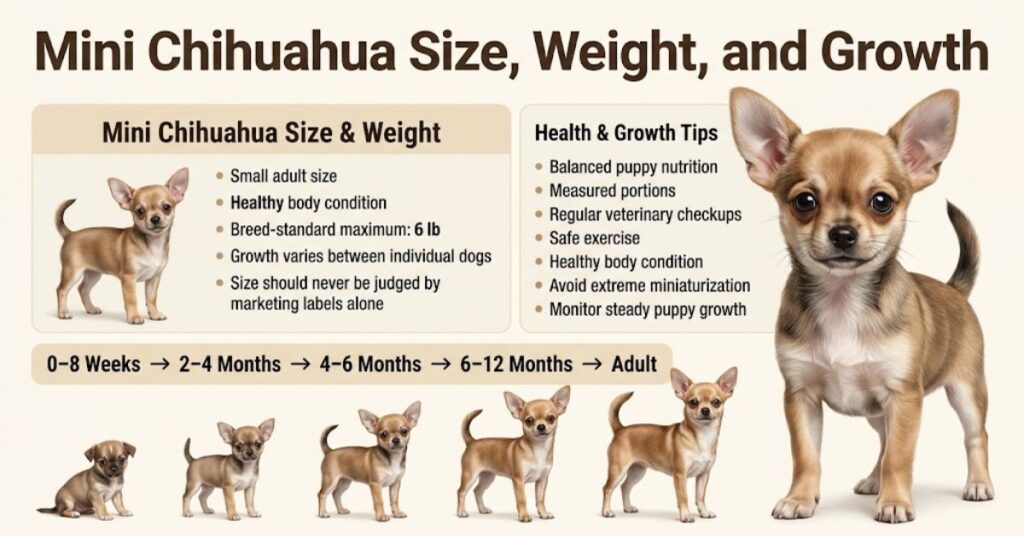
Mini Chihuahua size can vary because the term has no official measurement. The most useful reference remains the Chihuahua breed standard. According to the AKC, a Chihuahua should not exceed 6 pounds.
A puppy that weighs less than this does not automatically qualify as a special “miniature” type. Many healthy adult Chihuahuas naturally fall near the lower end of the breed’s size range.
| Chihuahua Type or Description | What It Means | Owner Consideration |
| Standard Chihuahua | Official breed category | Focus on a healthy body condition |
| Small Chihuahua | Informal description | Size alone does not determine health |
| Mini Chihuahua | Marketing or informal size term | Ask about adult size and health history |
| Teacup Chihuahua | Informal marketing term | Be cautious about extreme miniaturization |
| Very underweight Chihuahua | Possible health concern | Veterinary assessment may be needed |
Growth should be evaluated over time rather than by one puppy’s weight. Puppies grow at different rates, and a breeder’s prediction cannot guarantee adult size.
A responsible breeder should provide the puppy’s birth information, veterinary records, vaccination history, parasite-control history, and information about the parents. Ideally, you should meet the mother and observe the puppy’s environment.
Do not choose a puppy solely because it is the smallest one available. Extremely tiny puppies can require more careful monitoring for nutrition, temperature regulation, injuries, and other problems.
Body condition matters more than the number on a scale. You should be able to feel the ribs without seeing sharply protruding bones. A veterinarian can assess whether a puppy is growing appropriately.
Our Miniature Pomeranian complete care guide also explains why extreme size labels can confuse buyers of toy breeds. The same general lesson applies here: health should come before marketing language.
Mini Chihuahua Temperament and Training
Mini Chihuahua temperament usually resembles the broader Chihuahua personality rather than creating a completely different type of dog. These dogs are often alert, confident, loyal, curious, and expressive. The AKC describes the breed as alert with terrier-like confidence and self-reliance.
Their intelligence can make training rewarding, but their small size can cause owners to make one important mistake: allowing behaviors that would not be acceptable from a larger dog.
For example, some owners laugh when a Chihuahua barks at visitors because the behavior looks funny. Later, the barking becomes difficult to control. Others carry their dog everywhere instead of allowing safe exploration, which can limit socialization.
Mini Chihuahuas should receive positive, consistent training. Reward desired behavior with tiny treats, praise, play, or access to something the dog enjoys. Avoid hitting, harsh leash corrections, or frightening punishment.
Short sessions work best. Five minutes of focused training several times a day can be more productive than one long session.
Useful early skills include:
- Responding to their name.
- Coming when called.
- Walking calmly on a harness.
- Sitting and waiting.
- Accepting gentle handling.
- Staying comfortable around household sounds.
- Using an appropriate toilet routine.
- Settling calmly when visitors arrive.
Socialization also matters. Introduce your puppy gradually to safe people, sounds, surfaces, handling, and environments. Because very small dogs can be injured by larger dogs, choose playmates carefully and supervise interactions.
The AKC specifically recommends giving toy breeds opportunities to learn, exercise, socialize, and participate in appropriate activities rather than treating them as accessories.
Feeding a Mini Chihuahua Safely
Feeding a Mini Chihuahua requires careful portion control because a tiny dog can gain excess weight from surprisingly small amounts of food. At the same time, puppies that are extremely small may be vulnerable to inadequate calorie intake.
Start with a complete and balanced food appropriate for the dog’s life stage. The FDA explains that a nutritional adequacy statement helps owners determine whether a pet food is intended to provide a complete and balanced diet.
Do not select food simply because the package says “premium,” “natural,” or “small dog.” Look at the nutritional adequacy statement, feeding instructions, calorie content, and your dog’s individual needs.
Very small dogs may find large kibble difficult to manage. A small-breed formula with appropriately sized pieces can make eating easier. Some dogs also do well with wet food or a combination of wet and dry food, provided the complete diet remains nutritionally appropriate.
| Care Stage | Feeding Approach | What to Monitor |
| Young puppy | Several small meals according to veterinary guidance | Energy, appetite, stool, growth |
| Growing Chihuahua | Measured puppy diet | Weight and body condition |
| Healthy adult | Measured complete adult diet | Weight, activity, stool |
| Senior Chihuahua | Individualized senior nutrition | Weight, teeth, mobility, appetite |
| Very tiny or medically fragile dog | Veterinary-directed plan | Blood glucose, appetite, growth, energy |
Avoid guessing portions from another Chihuahua. Two dogs of the same weight can have different calorie requirements because of age, activity, metabolism, reproductive status, and health.
Treats should remain a small part of the daily calorie intake. Tiny pieces are enough for training.
Watch for sudden weakness, unusual sleepiness, poor coordination, trembling, collapse, vomiting, or refusal to eat, particularly in a very young or extremely small puppy. These signs can have several causes, including low blood glucose, illness, stress, or inadequate food intake. A puppy showing severe or sudden symptoms needs prompt veterinary attention.
For more dog-food selection guidance, our Kirkland Dog Food Review discusses small-dog feeding considerations such as kibble size and portion control.
FDA: Complete and Balanced Pet Food
Mini Chihuahua Grooming and Dental Care
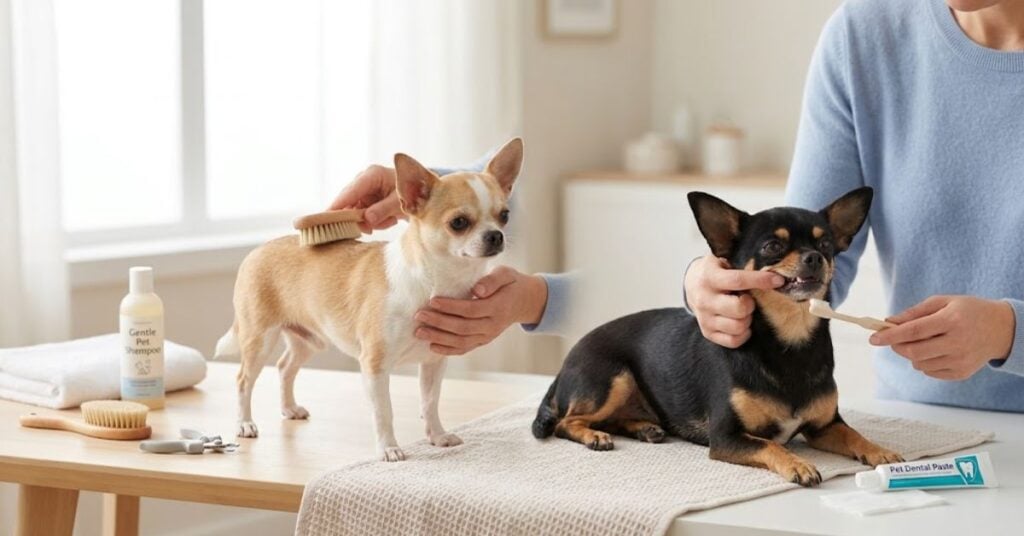
Mini Chihuahua grooming is usually manageable, but dental care deserves special attention. The Chihuahua’s tiny mouth can become crowded, and small dogs commonly need diligent oral hygiene.
Smooth-coated Chihuahuas generally need occasional brushing to remove loose hair and keep the coat clean. Long-coated Chihuahuas benefit from more frequent brushing, especially around the ears, neck, legs, and tail, where tangles can develop.
A soft brush or small comb should be used gently. Do not pull through mats aggressively. If a mat is tight against the skin, a professional groomer or veterinarian may be safer than trying to cut it out with scissors.
Bathing should depend on lifestyle and skin condition. Too many baths can dry or irritate the skin. Use a dog-specific shampoo rather than human shampoo.
Nails should be checked regularly. Overgrown nails can change the way a small dog walks and may make movement uncomfortable.
Ear checks should also become part of the routine. Look for redness, strong odor, discharge, swelling, or persistent scratching.
Dental care deserves daily attention whenever possible. Introduce tooth brushing gradually and use toothpaste made for dogs. Never use human toothpaste unless a veterinarian specifically directs you to do so.
Mini Chihuahua Care Checklist
- Brush the coat according to the coat type.
- Check ears weekly.
- Trim nails before they become overgrown.
- Brush teeth regularly.
- Check the mouth for odor, redness, or discomfort.
- Examine paws after outdoor walks.
- Keep grooming sessions short and calm.
- Reward cooperative behavior.
A useful weekly routine is to combine grooming with a gentle body check. Run your hands over the coat, paws, ears, legs, and abdomen. You are not diagnosing disease; you are learning what is normal for your individual dog.
Our best dog food for Yorkies guide also discusses the importance of nutrition for toy-breed dental and overall health.
Mini Chihuahua Health Problems and Warning Signs
A healthy Mini Chihuahua can live for many years, but extreme smallness can make safety and health management more important. The goal should never be to create the smallest possible dog. The goal should be a structurally sound, healthy companion.
Potential concerns include dental disease, patellar luxation, injuries from falls, hypoglycemia in vulnerable puppies, obesity, eye problems, and respiratory or other medical conditions that can occur in individual dogs.
Dental disease deserves particular attention. Small dogs can develop significant plaque and tartar, and untreated oral disease can cause pain and affect overall health.
Patellar luxation occurs when the kneecap moves out of its normal position. You may notice intermittent skipping, holding up a rear leg, stiffness, or an unusual gait. A veterinarian should evaluate these signs rather than assuming the dog is simply being playful.
A Mini Chihuahua can also be injured by ordinary household situations. A jump from a sofa may be minor for a large dog but dangerous for a tiny dog. Being stepped on, dropped, or grabbed roughly can cause serious trauma. Use a safety scale to decide how quickly to respond:
Green: Normal appetite, energy, breathing, walking, and bathroom habits. Continue routine care.
Yellow: Mild change lasting more than a short period, such as reduced appetite, new coughing, persistent scratching, or altered movement. Contact your veterinarian for advice.
Red: Collapse, severe weakness, difficulty breathing, repeated vomiting, seizures, inability to stand, severe pain, major trauma, or sudden neurological changes. Seek urgent veterinary care.
This scale is a monitoring framework, not a diagnosis. A very small puppy can deteriorate quickly, so trust your observations and contact a veterinarian when something feels significantly wrong.
Our Chihuahua shaking guide can help owners distinguish common causes of trembling from signs that need closer attention.
Mini Chihuahua Safety, Exercise, and Daily Care
A Mini Chihuahua still needs exercise, mental stimulation, and exploration. The right approach is controlled activity rather than trying to exhaust the dog.
Several short walks or play sessions can work well. Indoor games, scent activities, simple obedience exercises, and food puzzles can provide mental stimulation without requiring long-distance exercise.
Safety becomes especially important because of the dog’s size.
Keep your Chihuahua away from unsafe heights. Consider pet steps or ramps for favorite furniture if your dog frequently climbs on and off sofas or beds. Baby gates can also help prevent falls down stairs.
Supervise interactions with larger dogs. Even a friendly large dog can accidentally injure a tiny Chihuahua during play.
Crowded public areas require additional attention. A very small dog can be difficult for pedestrians to notice. When necessary, use a secure carrier or hold your dog safely while moving through dense crowds.
Avoid letting your Chihuahua jump repeatedly from high furniture. Repeated impact can place unnecessary stress on small joints.
Temperature also matters. Chihuahuas can become uncomfortable in cold weather because of their small bodies and relatively limited insulation. A properly fitted sweater may help some dogs outdoors, but it should never replace sensible limits on exposure.
At the same time, do not overprotect your dog from every new experience. The goal is confident, safe exposure. A practical weekly care schedule looks like this:
Daily: Fresh water, measured meals, toilet breaks, short exercise, training, and a quick health observation.
Several times weekly: brushing, interactive play, paw checks, and dental care practice.
Weekly: Full coat and skin check, ear inspection, nail check, weight or body-condition review, and equipment inspection.
Regularly: Veterinary wellness care, vaccinations, parasite prevention, dental assessment, and individualized screening.
Choosing a Healthy Mini Chihuahua Puppy
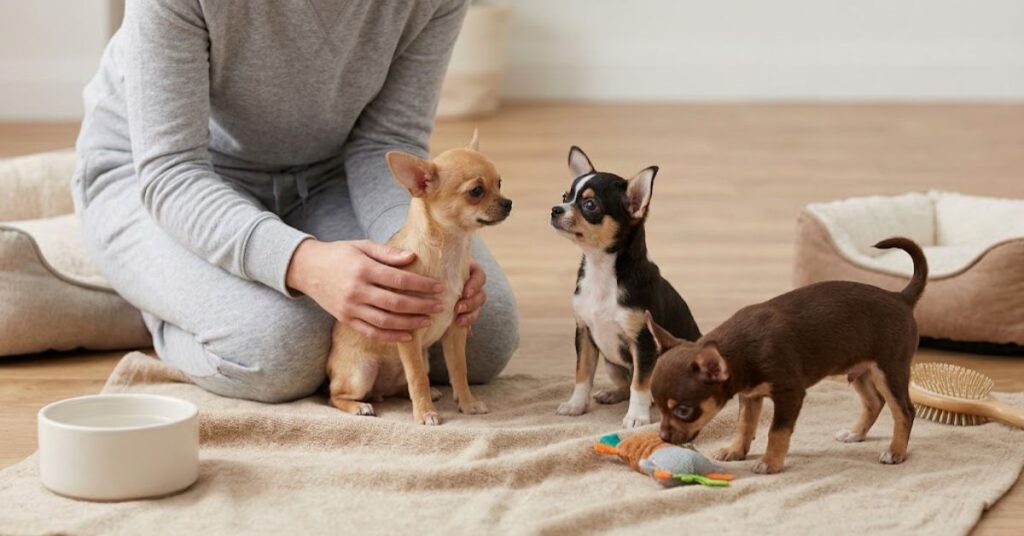
If you are searching for a Mini Chihuahua puppy, resist the temptation to choose the smallest puppy simply because it looks cute. Responsible breeding should prioritize health, temperament, sound structure, and appropriate development.
Ask the breeder how they define “mini.” A good breeder should answer clearly rather than rely on dramatic labels such as “micro” or “super teacup.”
Ask to see veterinary records. You should know the puppy’s vaccination status, parasite-control history, age, diet, and general health information.
Meeting the mother is valuable because it lets you observe her temperament and condition. If possible, ask about the father’s and family’s health history too.
Be cautious if a seller:
- Promises an exact adult weight.
- Claims a puppy is healthier because it is extremely tiny.
- Refuses to show health records.
- Wants to sell the puppy unusually young.
- Avoids questions about the parents.
- Pressures you to pay immediately.
- Uses “teacup” as the main selling point.
- Cannot explain the puppy’s feeding and veterinary routine.
A responsible breeder should also ask you questions. They should care where the puppy will live, how you plan to care for it, and whether your household is appropriate for a tiny dog.
If you are adopting rather than buying, the same health principles apply. Ask the rescue or shelter about the dog’s medical history, behavior, vaccination status, and known needs.
The best Mini Chihuahua is not necessarily the smallest one. It is the one with good overall health, stable temperament, appropriate development, and a responsible beginning.
Frequently Asked Questions About Mini Chihuahua Dogs
Is a Mini Chihuahua a separate breed?
No. Mini Chihuahua is an informal description, not a separate breed recognized by the AKC. The Chihuahua breed itself has a maximum standard weight of 6 pounds. A particularly small Chihuahua may be called “mini,” but the label does not guarantee a specific adult size, health level, or genetic type.
How much does a Mini Chihuahua weigh?
There is no official Mini Chihuahua weight range. The AKC Chihuahua standard sets a maximum weight of 6 pounds. Individual dogs can naturally fall below that limit. Owners should focus on a healthy body condition and normal growth rather than trying to make a Chihuahua as small as possible.
Are Mini Chihuahuas healthy?
Some very small Chihuahuas are healthy, but extreme smallness can increase practical risks. Tiny puppies may be more vulnerable to low blood glucose, injury, poor growth, and other complications. A veterinarian should monitor unusually small puppies and investigate weakness, poor appetite, abnormal movement, or sudden behavior changes.
What should I feed a Mini Chihuahua?
Choose a complete and balanced food suitable for the dog’s age and nutritional needs. Small kibble may be easier for a tiny mouth. Measure portions carefully and divide puppy meals according to veterinary guidance. Avoid copying another dog’s feeding amount because calorie requirements vary between individuals.
How long can a Mini Chihuahua live?
Chihuahuas are generally long-lived small dogs. The AKC lists an average lifespan of about 15–17 years, although individual dogs can live shorter or longer lives. Genetics, dental health, body weight, nutrition, preventive veterinary care, exercise, and accident prevention all influence long-term health.
Conclusion
A Mini Chihuahua can be a loving, intelligent, entertaining companion, but the word “mini” should never become more important than health. The Chihuahua is already a naturally tiny breed, and the AKC standard recognizes dogs weighing no more than 6 pounds. Extremely small marketing labels do not represent a separate official breed variety.
When caring for a very small Chihuahua, focus on the basics that make a real difference: complete nutrition, measured portions, dental care, gentle grooming, positive training, safe exercise, socialization, regular veterinary care, and protection from falls or rough play.
If you are choosing a puppy, investigate the breeder rather than buying because of a “teacup” or “micro” label. Ask about the parents, veterinary records, growth, temperament, and daily care. A slightly larger puppy with strong health and sound development is often a much better choice than an extremely tiny puppy produced mainly for appearance.
Your Mini Chihuahua does not need to be the smallest dog in the room. It needs to be healthy, confident, comfortable, and loved. With thoughtful daily care and sensible safety precautions, this tiny companion can enjoy an active and rewarding life beside you.
Multimedia Placement Suggestions
- Featured Image: Place directly below the article title. Show a healthy small Chihuahua standing naturally beside a size-reference object.
- Grooming Flowchart: Place after the grooming section. Show brushing teeth, ears, nails, and bathing in a simple weekly flow.
- Comparison Graphic: Place after the size section. Compare official Chihuahua terminology with informal “Mini” and “Teacup” labels.
- Before & After Image: Place in the grooming section, showing a long-coated Chihuahua before and after gentle coat maintenance.
- YouTube Video/Thumbnail: Place after the training and safety sections. Use a video demonstrating safe handling and positive-reinforcement training.
- Pinterest Image: Create a vertical summary graphic featuring “Mini Chihuahua Care Checklist” with feeding, grooming, exercise, and safety tips.
Tags
Mini Chihuahua, Mini Chihuahua puppy, Chihuahua, tiny Chihuahua, miniature Chihuahua, teacup Chihuahua, Chihuahua care, Chihuahua health, Chihuahua grooming, Chihuahua feeding, Chihuahua training, small dog care
Primary Keywords: Mini Chihuahua, Mini Chihuahua puppy, small Chihuahua
Secondary Keywords: Mini Chihuahua size, Mini Chihuahua care, Mini Chihuahua health, Mini Chihuahua temperament, Mini Chihuahua feeding
Related Keywords: tiny Chihuahua, miniature Chihuahua, teacup Chihuahua, small dog care, Chihuahua puppy, toy breed, Chihuahua weight, Chihuahua grooming, Chihuahua dental care, hypoglycemia in puppies, puppy socialization, positive reinforcement, small dog nutrition, patellar luxation, Chihuahua lifespan
Social Media Caption
Tiny body, huge personality! 🐶❤️ Learn everything about Mini Chihuahuas, from size and feeding to grooming, health, training, and puppy safety. #MiniChihuahua #Chihuahua #ChihuahuaPuppy #SmallDogs #DogCare #PetCare #ChihuahuaNest