

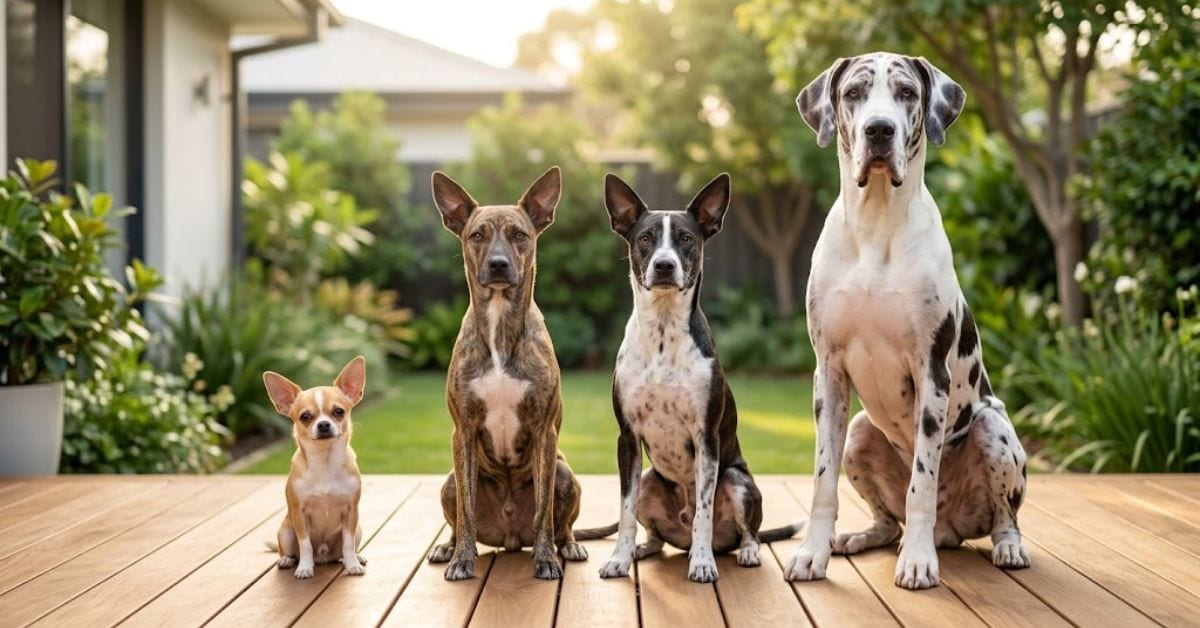
Quick Answer
A Chihuahua-Great Dane mix is an extremely unusual cross between two dogs with a dramatic size difference. It is not an established breed, and reliable information about adult size, lifespan, and appearance is limited.
Because breeding dogs of such different sizes can raise serious welfare concerns, owners should focus on individual veterinary assessments rather than online breed claims.
Author Bio
Author: Gulnaz Malik
Role: Publisher & Pet Care Expert
Experience: 5+ Years in Dog Care & Dog Grooming
Content Review: Veterinary-reviewed content approach based on trusted canine care resources and practical pet care experience.
Introduction
The Chihuahua-Great Dane mix is one of the most unusual dog combinations people search for online. A Chihuahua represents one of the smallest recognized dog types, while the Great Dane ranks among the tallest and heaviest breeds. That enormous difference makes this proposed mix very different from common crosses such as a Pomchi or Jack Chi.
Reliable documentation of naturally produced Chihuahua Great Dane puppies is extremely limited. Some websites describe supposed examples, but those claims should be treated cautiously rather than as proof of an established designer breed. The extreme physical difference between the parents also creates important animal-welfare questions. (Hepper Pet Resources)
That does not mean the topic is useless for dog owners. Quite the opposite. If you have encountered a dog advertised as a Chihuahua-Great Dane mix, you need to know how to evaluate its size, structure, behavior, health, nutrition, and veterinary needs without relying on a breed label.
This guide explains what science can reasonably tell us, what remains uncertain, and how to care for an individual dog if you genuinely encounter one. You will also learn about possible inherited health concerns, feeding principles, exercise, grooming, training, and important safety precautions.
Important: A mixed-breed dog should be assessed as an individual. A label cannot predict its exact adult size, temperament, or medical needs.
What Is a Chihuahua-Great Dane Mix?
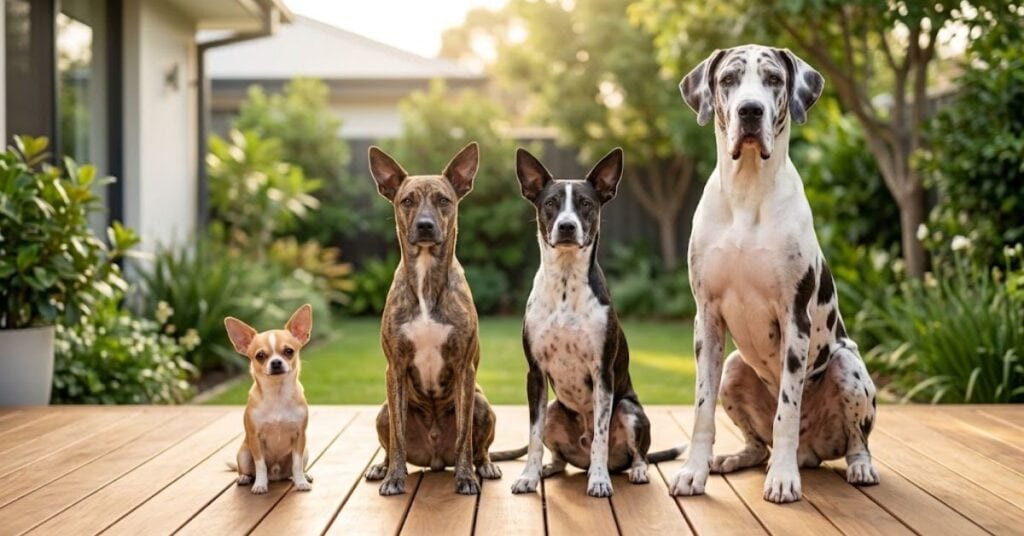
The Chihuahua-Great Dane mix would theoretically combine a Chihuahua with a Great Dane. These parent breeds differ dramatically in body size, bone structure, proportions, and typical physical characteristics.
Great Danes commonly stand around 28–32 inches tall and may weigh roughly 110–175 pounds. Chihuahuas are dramatically smaller. The American Kennel Club lists the Great Dane as a giant breed and emphasizes that its size, strength, and care requirements entail a significant commitment. (American Kennel Club)
That contrast is the first thing owners should understand.
A cross between two breeds does not automatically produce an exact 50/50 physical blend. Genetics is more complicated than simply taking half the appearance of one parent and half of the other. Coat, skull shape, bone structure, height, body length, temperament, and health traits can all vary.
However, with a Chihuahua-Great Dane cross, predicting the result becomes especially difficult because the parents sit at opposite ends of the canine size spectrum.
There is also a crucial distinction between theoretical possibility and responsible breeding. Sources discussing this cross point out that the enormous size difference creates major reproductive and welfare challenges. (Hepper Pet Resources)
Parent breed comparison
| Feature | Chihuahua | Great Dane | Potential mix |
| General size | Toy/small | Giant | Highly unpredictable |
| Typical build | Compact | Tall and powerful | Could vary considerably |
| Coat | Smooth or long | Short and smooth | Usually difficult to predict |
| Personality | Alert, bold, devoted | Gentle, friendly, dependable | Individual variation expected |
| Exercise | Moderate | Moderate with substantial daily movement | Depends on body structure |
| Major concerns | Dental and kneecap issues | Joint, heart, and bloat concerns | Possible risks from either lineage |
Because this is not an established breed with a recognized breed standard, there is no official size chart or guaranteed adult appearance. Be skeptical of websites that state exact measurements as though every Chihuahua-Great Dane mix will reach them.
If you have found a dog being sold under this label, ask for documentation about its parents, veterinary history, microchip information, vaccination records, and breeding history. A DNA test can sometimes help identify ancestry, although it cannot predict every health outcome.
For comparison, ChihuahuaNest also covers established crosses such as the Jack Russell and Chihuahua mix, where the parent breeds have much more compatible physical proportions.
Chihuahua Great Dane Mix Size and Appearance
The Chihuahua-Great Dane mix size cannot be predicted with confidence because there is no recognized breed standard and very little reliable population data.
You may find websites claiming that this cross reaches a particular height or weight. Treat those figures as speculative unless they come with reliable pedigree and veterinary documentation.
The Great Dane side can contribute a tall frame, long legs, a deep chest, large paws, and a short, smooth coat. The Chihuahua side may contribute a smaller head, expressive eyes, alert behavior, compact features, or a finer body structure.
Genetics does not always distribute these characteristics evenly.
A dog could potentially look more like one parent than the other. Even puppies from the same litter can show meaningful variation when different genes influence body shape and growth.
Coat characteristics can also vary. Both parent breeds can have short coats, but Chihuahuas may have either smooth or long coats. Therefore, coat length and texture should be evaluated from the actual dog rather than assumed from the name.
Color can be equally unpredictable. Great Danes appear in several recognized colors and patterns, while Chihuahuas also display considerable color variation.
What owners should measure
- Adult weight
- Shoulder height
- Body length
- Chest depth
- Body condition score
- Paw and limb structure
- Head and muzzle shape
- Coat length and density
- Movement and gait
Body condition matters more than the number on a scale.
A tall dog can still become overweight, and excessive body fat places additional stress on joints. Conversely, a very lean appearance may indicate inadequate nutrition, illness, or another underlying problem.
Great Danes already face substantial physical demands because of their giant size. Large and giant dogs can develop mobility challenges and joint problems as they age. (American Kennel Club)
For a dog with unusual proportions, monitoring movement becomes especially important.
Watch for limping, stiffness after rest, reluctance to climb stairs, difficulty rising, repeated slipping, or changes in walking speed. These signs deserve veterinary attention rather than being dismissed as normal behavior.
If the dog is still growing, avoid trying to make it grow faster. Rapid growth can place excessive stress on developing bones and joints. Large-breed puppies require carefully controlled nutrition rather than simply more calories. (American Kennel Club)
Chihuahua Great Dane Mix Temperament and Personality
The Chihuahua-Great Dane mix’s temperament would likely be difficult to predict because both parent breeds have distinctive but very different behavioral tendencies.
Chihuahuas are often alert, confident, devoted, and vocal. They can form strong bonds with their owners and may become protective of their home or favorite person.
Great Danes are generally known for their gentle, friendly, patient nature. The American Kennel Club describes them as imposing in size but typically affectionate and dependable companions. (American Kennel Club)
A hypothetical mix could inherit characteristics from either side.
One individual might be calm and affectionate. Another might be more alert, vocal, or cautious around strangers. Early socialization can strongly influence how a dog responds to unfamiliar people, animals, environments, sounds, and handling.
Size also changes the training equation.
A Chihuahua that pulls toward another dog may be inconvenient. A large, powerful dog that pulls can be genuinely difficult to control. Therefore, leash manners should begin early and remain consistent.
Use reward-based training. Give the dog a clear behavior, reward the correct response, and repeat it in different environments.
Avoid punishment-based methods that rely on fear or physical force. They can damage trust and may worsen defensive behavior.
Socialization should also be gradual. Do not force a nervous puppy into crowded environments simply because you want it to “get used to people.” Instead, expose the dog to new experiences at a manageable distance and reward calm behavior.
A Chihuahua-Great Dane mix could also have a strong attachment to its owner. Separation-related behaviors may develop if the dog never learns to spend short periods alone.
Build independence gradually.
Provide a comfortable resting area, safe enrichment toys, predictable routines, and short periods of separation. Increase the duration slowly while monitoring stress signals.
For owners interested in how another Chihuahua cross can behave, ChihuahuaNest’s Pomeranian Chihuahua mix guide provides a useful comparison of mixed-breed temperament and care.
Chihuahua Great Dane Mix Health Problems
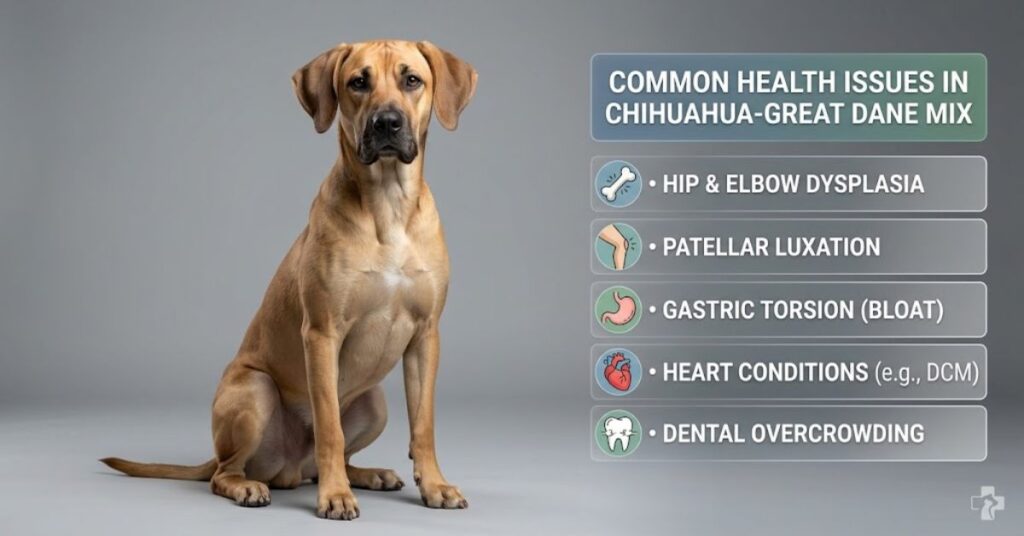
Health is one of the most important reasons to approach the Chihuahua-Great Dane mix carefully.
A mixed-breed label does not automatically protect a dog from inherited disease. A cross can inherit genetic risks from either parent, and the actual risk depends on the individual dog’s ancestry.
The Great Dane side raises particular concern about conditions associated with giant breeds. Great Danes are predisposed to serious problems, including gastric dilatation-volvulus (GDV), heart disease, joint disease, and certain neurological conditions. (PetMD)
The Chihuahua side can contribute a different set of concerns, including dental crowding and patellar luxation.
Potential health-monitoring checklist
- Gait: Watch for limping, stiffness, skipping, or unusual movement.
- Heart: Ask your veterinarian whether cardiac screening is appropriate.
- Digestive signs: Treat repeated abdominal swelling, retching, or severe distress as urgent.
- Teeth: Inspect regularly for crowding, tartar, bad breath, or difficulty chewing.
- Knees: Watch for intermittent skipping or sudden lifting of a rear leg.
- Weight: Monitor body condition rather than feeding to appearance alone.
- Neurological signs: Report weakness, wobbling, neck pain, or coordination changes.
- Skin and coat: Investigate persistent itching, hair loss, redness, or sores.
Bloat deserves special attention if the dog develops a deep chest similar to that of a Great Dane. GDV is a life-threatening emergency in which the stomach becomes distended and can twist. Great Danes are among the breeds commonly associated with increased GDV risk. (PetMD)
Signs can include repeated unproductive retching, abdominal enlargement, restlessness, drooling, weakness, or collapse.
Do not wait to see whether these signs disappear. Contact an emergency veterinarian immediately.
The opposite mistake is also dangerous: assuming every health problem comes from the breed label. If a dog shows unusual symptoms, let a veterinarian examine that individual dog.
A wellness plan should consider age, actual body size, family history, previous medical records, vaccination status, parasite prevention, dental health, and lifestyle.
This is more useful than relying on generic “Chi-Dane-Dane” health lists found online.
Feeding a Chihuahua-Great Dane Mix
Nutrition may be one of the most complicated aspects of caring for a Chihuahua-Great Dane mix, particularly if the dog grows toward a large adult size.
You should never choose food simply because the label says “small breed,” “large breed,” or “all breeds.” Instead, consider the dog’s actual growth pattern and veterinary assessment.
Puppies with substantial large-breed growth potential require careful calorie and mineral management. Excessive growth can increase orthopedic stress. The AKC notes that giant-breed puppies need different feeding strategies from toy-breed puppies because their growth rates and nutritional requirements differ dramatically. (American Kennel Club)
The FDA also explains that owners should look for a nutritional adequacy statement showing that a food is complete and balanced for the appropriate life stage. (U.S. Food and Drug Administration)
FDA guidance on complete and balanced pet food
| Life stage | Main feeding priority | What to monitor |
| Puppy | Controlled growth and balanced nutrients | Weight, growth rate, stool, joints |
| Young adult | Lean body and muscle support | Calories, activity, body condition |
| Adult | Stable weight and complete nutrition | Waistline, energy, digestion |
| Senior | Weight control and individual health needs | Mobility, appetite, muscle loss |
Feed measured portions rather than leaving food available all day.
The correct amount depends on the dog’s weight, age, activity, body condition, and the calorie density of the food. Package feeding guides provide a starting point, not an exact prescription.
Treats also count toward daily calories.
For puppies, avoid supplements containing extra calcium or other minerals unless your veterinarian specifically recommends them. Adding nutrients to a complete diet can create an imbalance.
Fresh water should always be available.
If the dog has digestive problems, do not keep switching foods every few days. Rapid diet changes can cause diarrhea and make it difficult to determine what caused the problem.
When changing diets, transition gradually unless your veterinarian gives you different instructions.
Owners can also review ChihuahuaNest’s Eukanuba dog food guide when comparing commercial diet options, but the final choice should match the individual dog’s nutritional needs.
Exercise, Grooming, and Daily Care
A Chihuahua-Great Dane mix needs exercise based on its actual structure, age, and fitness rather than its unusual name.
A young, healthy dog may enjoy walks, sniffing games, training sessions, and controlled play. However, growing puppies should not be pushed into excessive repetitive exercise.
Large-frame puppies need time for bones and joints to develop. Avoid forcing a puppy to run long distances, repeatedly jump from furniture, or perform high-impact activities.
Adult exercise should maintain lean muscle without causing exhaustion.
A useful approach is to combine physical activity with mental enrichment. Five to ten minutes of basic training can provide valuable stimulation, especially when combined with scent games or puzzle feeding.
Grooming is generally manageable if the dog inherits a short coat. Brush once or twice a week and inspect the ears, skin, paws, and nails regularly.
If the dog inherits a longer Chihuahua-type coat, brushing may need to happen more frequently.
Nail care matters because long nails can change foot placement and movement. ChihuahuaNest’s best dog nail clippers for small dogs guide explains safe nail-care principles that can be adapted to the dog’s actual nail size.
Weekly care framework
- Monday: Body-condition check and weight monitoring
- Tuesday: Short training session plus normal exercise
- Wednesday: Brush coat and inspect skin
- Thursday: Check ears and paws
- Friday: Teeth inspection and dental-care routine
- Saturday: Longer enrichment session or relaxed outdoor walk
- Sunday: Full-body health check and rest
This simple routine can help owners notice changes before they become major problems.
Look for new lumps, irritated skin, unusual odor, ear discharge, cracked nails, dental buildup, changes in appetite, or altered movement.
Early detection does not guarantee prevention, but it gives your veterinarian a better chance to investigate problems while they are manageable.
Chihuahua Great Dane Mix Training and Safety
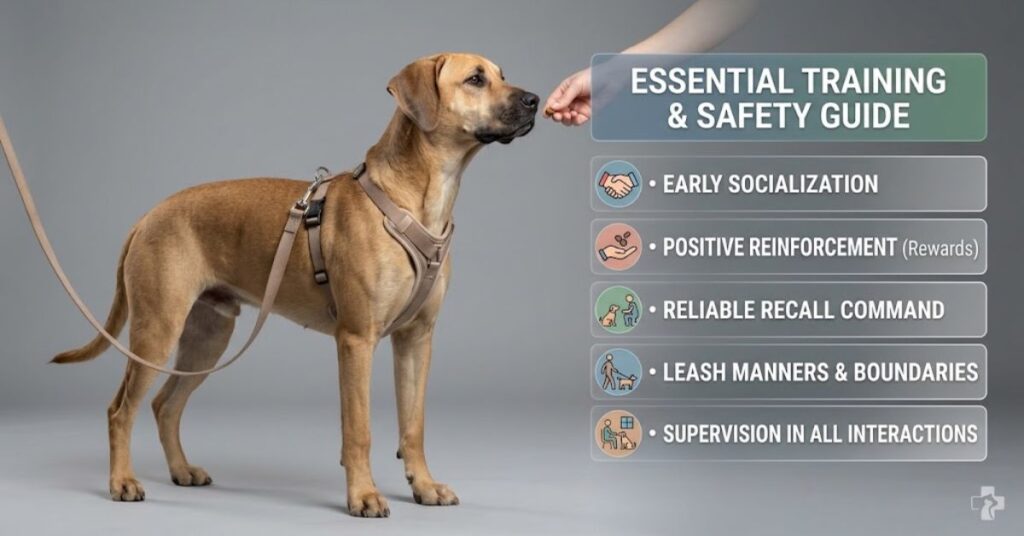
Training should begin as soon as the dog settles into its new home.
The most important commands include sit, stay, come, leave it, drop it, wait, and loose-leash walking.
These skills matter even more when a dog may become large and strong.
A large dog with poor leash manners can pull an adult off balance. If the dog also shows Chihuahua-like alertness or reactivity, uncontrolled encounters with other dogs can become difficult.
Start indoors with low distractions.
Reward the dog for looking at you, walking beside you, sitting calmly, and responding to its name. Then gradually increase distractions.
Do not allow unwanted behavior to become a daily habit. If jumping on visitors is cute at eight weeks, it will not be cute when the dog becomes much larger.
Safety around children also requires careful management.
Never leave a child unsupervised with a dog simply because the dog appears gentle. Children should learn not to climb on dogs, pull ears or tails, disturb sleeping animals, or take food from their bowls.
Use barriers when necessary.
A mixed dog with unusual proportions may also have different physical limitations. Do not assume that because one parent is athletic, the offspring can safely perform the same activities.
If the dog shows neck pain, weakness, limping, repeated falls, difficulty breathing, or exercise intolerance, stop strenuous activity and contact your veterinarian.
A responsible owner should also keep identification and vaccination records current.
If you are comparing different Chihuahua crosses, ChihuahuaNest’s Dachshund-mixed Chihuahua guide offers another example of why body structure and inherited traits matter when planning daily care.
Is a Chihuahua-Great Dane Mix Right for You?
The answer depends less on the unusual name and more on the actual dog.
If someone is advertising a “Chihuahua Great Dane puppy,” ask detailed questions before paying money.
Request information about the parents, breeding method, veterinary records, vaccination history, microchip information, and health screening. Be especially cautious if the seller cannot explain how the parents were safely paired.
Extreme size differences should never be treated as a novelty breeding experiment.
If a dog already exists and you are considering adoption, focus on the individual animal rather than whether the advertised breed name is scientifically accurate.
Have the dog examined by a veterinarian.
Ask the veterinarian to evaluate:
- Heart and respiratory health
- Orthopedic structure
- Body condition
- Teeth and gums
- Knees and hips
- Neurological function
- Vaccination status
- Parasite prevention
- Nutrition and growth
- Future monitoring needs
Care Do’s and Don’ts
Do:
- Get a veterinary examination.
- Track weight and body condition.
- Feed a complete and balanced diet.
- Use reward-based training.
- Socialize gradually.
- Monitor movement.
- Maintain dental and nail care.
- Keep emergency veterinary information available.
Don’t:
- Trust exact online size predictions.
- Encourage rapid puppy growth.
- Add calcium supplements without veterinary advice.
- Allow uncontrolled jumping from high furniture.
- Ignore repeated limping or weakness.
- Leave children unsupervised with a large dog.
- Attempt unsafe breeding because the cross seems unusual.
- Assume mixed-breed status eliminates inherited disease.
A responsible approach protects the dog first.
If your interest comes from seeing photographs online, remember that photographs can also be misleading. A dog can look unusually large or small depending on camera angle, distance, and the size of the surrounding objects.
Frequently Asked Questions
Is a Chihuahua-Great Dane mix a real dog?
The Chihuahua-Great Dane mix is discussed online, but reliable documentation of an established population is lacking. The extreme size difference between the parents makes this cross highly unusual and raises important breeding-welfare concerns. If someone claims to have one, verify veterinary records and parentage rather than relying only on the advertised breed name.
How big would a Chihuahua-Great Dane mix be?
There is no dependable adult size standard for this cross. Because it is not an established breed, online height and weight ranges are speculative. The actual dog’s parents, genetics, sex, growth pattern, and body structure would provide more useful information than a generic internet estimate.
What health problems could this mix have?
Potential concerns could come from either parent. These may include orthopedic problems, heart disease, dental disease, patellar luxation, and GDV-related risk if the dog has a deep chest. Regular veterinary examinations are more useful than assuming a specific disease will occur because of the mix.
Can a Chihuahua and a Great Dane mate naturally?
The enormous difference in body size makes natural mating impractical and creates serious welfare concerns. Responsible breeding should never prioritize producing an unusual cross over the safety of the animals involved. Any reproductive plan involving such a size mismatch requires careful veterinary and welfare consideration.
What should I feed a Chihuahua-Great Dane mix?
Feed a complete and balanced diet appropriate for the dog’s actual age, growth stage, body size, and health. If the puppy has substantial large-breed growth potential, controlled nutrition becomes especially important. Ask your veterinarian to monitor growth instead of trying to accelerate it through extra calories or supplements.
Conclusion
The Chihuahua-Great Dane mix is fascinating because it combines two breeds that sit at opposite ends of the canine size spectrum. However, fascination should not replace responsible pet care.
Most importantly, there is no reliable breed standard that tells owners exactly how large, heavy, long-lived, or predictable this cross will be. Online claims about exact measurements should therefore be treated carefully.
The extreme size difference between the parent breeds also makes responsible breeding a serious welfare issue. If you encounter a dog described as a Chihuahua-Great Dane mix, focus on the animal in front of you. A veterinary examination, accurate weight tracking, body-condition monitoring, balanced nutrition, appropriate exercise, and positive training will provide much more useful information than the label.
Pay particular attention to movement, dental health, weight, heart health, and signs of digestive emergencies. If the dog develops severe abdominal swelling, repeated unproductive retching, weakness, collapse, or breathing difficulty, seek emergency veterinary care.
The best approach is simple: care for the individual dog, verify claims, and never treat an unusual crossbreed as a novelty experiment. With thoughtful management and professional veterinary guidance, you can make safer decisions for any dog, regardless of its ancestry.
Multimedia Placement Suggestions
- Featured Image: A realistic side-by-side Chihuahua and Great Dane with the article title over a clean background.
- Comparison Graphic: Chihuahua vs. Great Dane size, body structure, temperament, and care needs.
- Infographic: “Chihuahua Great Dane Mix: What Owners Should Monitor.”
- Care Flowchart: Nutrition → exercise → grooming → training → veterinary checks.
- YouTube Thumbnail: Chihuahua and Great Dane silhouettes with “Does This Mix Really Exist?”
- Pinterest Image: Vertical infographic featuring the key health and care points.
Tags
Chihuahua Great Dane Mix, Great Dane Chihuahua Mix, Chi Dane Dane, Chihuahua Mix, Great Dane Mix, Chihuahua Health, Great Dane Health, Mixed Breed Dogs, Dog Care, Dog Health
Social Media Caption
Curious about the Chihuahua-Great Dane mix? 🐶 Learn what science says about this extremely unusual cross, including size, temperament, health risks, feeding, training, grooming, and responsible breeding concerns. #Chihuahua #GreatDane #ChihuahuaMix #DogCare #DogHealth #DogLovers