Genetics, Care, Health, Grooming & Everything You Need to Know
By Dr. Gulnaz Malik, DVM, MSc Animal Nutrition
The Black Pomeranian is one of the most striking variations of this popular toy breed. With its jet-black coat and lively personality, a Black Pomeranian immediately turns heads wherever it goes.
Phones come out, people stop mid-sentence, and its dramatic, elegant appearance outshines cream-and-orange Pomeranians. Despite its show-stopping beauty, the Black Pomeranian remains one of the least understood color variations in the breed.
In this guide, you will learn exactly what makes a Pomeranian truly black at the genetic level, how to care for that striking dark coat, what health challenges to watch for, and what to expect when you bring one home. Whether you are a first-time Pom parent or a seasoned breeder, you will find depth here that goes well beyond the basics.
What Is a Black Pomeranian? Breed Overview and Origin
The Pomeranian belongs to the ancient Spitz family, a group of cold-weather dogs characterized by a dense double coat, pointed ears, and a curled tail carried over the back.
Breeders developed the modern “toy” Pomeranian in England during the 19th century, reducing the original working sled dog from a 30-pound animal to the 3–7 pound companion we recognize today. The American Kennel Club (AKC) officially recognizes the black Pomeranian as a distinct and desirable color, listing it in the breed standard alongside orange, sable, cream, and parti-color variants.
The solid black Pom displays a rich, glossy, ink-black coat from the tips of the guard hairs down through the undercoat. This uniform darkness is what separates a true black Pom from a heavily shaded black-and-tan or a dark wolf-sable, and that distinction begins at the DNA level.
Black Pomeranian Facts at a Glance
| Characteristic | Details |
|---|---|
| Breed Group | Toy (AKC) |
| Weight | 3 – 7 lbs (adult) |
| Height | 6 – 7 inches at the shoulder |
| Lifespan | 12 – 16 years |
| Coat Type | Double coat dense undercoat + long guard hairs |
| Energy Level | High |
| Shedding | Moderate to heavy (seasonal blows) |
| AKC Color Recognition | Yes — solid black is a recognized standard color |
Black Pomeranian: Genetic Insights
Most dog color guides stop at “black fur comes from melanin.” That is accurate but incomplete. To understand why two seemingly dark Pomeranians can produce completely different offspring, you need to look at two specific gene loci: the Extension (E) locus and the Agouti (A) locus.
Extension Gene (E Locus) in Black Pomeranians
The E locus controls whether a dog can produce black pigment (eumelanin) at all. A dog needs at least one dominant E allele (E/E or E/e) to express black or brown pigmentation in its coat. A dog that carries two recessive alleles (e/e) will be unable to produce eumelanin in the fur and will appear cream, red, or orange regardless of what other color genes it carries. This is why two orange Pomeranians, both carrying hidden e/e genotypes, can never produce a black puppy.
Black Pomeranian| The Agouti Gene (A Locus)
The A locus determines the distribution of pigment along each hair shaft. The dominant allele responsible for solid black expression is the “a” allele at the ASIP gene, which suppresses phaeomelanin (red/yellow pigment) production and allows eumelanin to dominate. A solid black Pomeranian typically carries the genotype a^t/a^t or a/a at this locus, resulting in uniform black pigmentation from root to tip.
The Sun Test: How to Identify a True Solid Black Pomeranian
Here is a practical field technique developed through observation in clinical and breeding settings. Take the dog outside into direct natural sunlight and gently part the fur down to the skin in three locations: behind the ears, at the base of the tail, and along the spine.
- True solid black: The undercoat appears uniformly dark grey-to-black. You see no brown, red, tan, or banded hairs anywhere.
- Dark sable: The undercoat reveals banded hairs; each shaft shows a lighter base with a dark tip. You will often spot red or gold tones at the roots.
- Dark chocolate: The coat appears black indoors but reveals warm reddish-brown tones in direct sunlight, especially at the skin level.
Running this test before purchasing a puppy saves considerable disappointment, since dark sable Poms often lighten significantly as they mature, a process called “clearing” that a true solid black will not undergo.
Genetic Combinations That Produce Black Offspring
| Parent 1 Genotype | Parent 2 Genotype | Probability of Black Offspring |
|---|---|---|
| Black (E/E, a/a) | Black (E/E, a/a) | 100% |
| Black (E/e, a/a) | Black (E/e, a/a) | 75% |
| Black (E/E, a/a) | Orange (e/e, any A) | 0% (all black carriers) |
| Black (E/e, a/a) | Orange (e/e, any A) | 0% (50% carriers) |
| Sable carrier (E/e) | Sable carrier (E/e) | 25% potentially black |
Black Pomeranian Coats & Heat| Warm Climate Tips

A black Pomeranian absorbs significantly more solar radiation than a cream or white Pom of identical size. Surface coat temperature comparisons conducted during outdoor activities in moderate sunlight (ambient 85°F / 29°C) reveal that black-coated small dogs can reach topcoat surface temperatures 15–22°F higher than their light-coated counterparts under the same conditions.
This matters enormously for a toy breed, because Pomeranians already carry a predisposition toward tracheal collapse and respiratory distress in heat. A black Pom overheats faster, tires sooner, and reaches dangerous core temperatures more quickly than a white Pom on the same walk.
Practical Heat Safety Guidelines for Black Pomeranian Owners
- Walk your black Pom before 8 a.m. or after 7 p.m. during the summer months.
- Keep outdoor play sessions under 15 minutes when temperatures exceed 80°F (27°C).
- Apply a dog-safe UV-protective coat spray to the topcoat before sun exposure. This reduces surface temperature and helps prevent coat bleaching.
- Carry a cooling bandana or portable misting fan on walks.
- Recognize early signs of overheating: rapid panting, excessive drooling, brick-red gums, and stumbling.
- Never leave a black Pom in a parked vehicle; the interior heats up 40°F faster than the outside temperature.
Case Study|Managing “Rusty Coat” Syndrome in the Black Pomeranians
One of the most common and distressing complaints from black Pomeranian owners is the gradual reddish-brown discoloration of the coat, a phenomenon often called “rusty coat” or “bronzing syndrome.” The fur that was once a rich jet black begins to fade to a dull rust color, starting at the tips and working inward. Several distinct causes drive this change.
Black Pomeranian| Causes of Coat Bronzing
| Cause | Mechanism | Primary Location |
|---|---|---|
| UV Sun Bleaching | Ultraviolet radiation degrades eumelanin pigment | Topcoat, spine, tail |
| Saliva Staining | Porphyrin pigments in saliva oxidize black fur to red-brown | Paws, face, chest |
| Nutritional Deficiency | Low omega-3, zinc, or tyrosine impairs melanin synthesis | Entire coat, uniform fade |
| Thyroid Imbalance | Hypothyroidism reduces pigmentation quality | Diffuse, with hair thinning |
| Alopecia X (Black Skin Disease) | Hormone-linked condition causes coat loss and discoloration | Trunk, sparing head and limbs |
| Hard Water Mineral Deposits | Calcium and magnesium coat the hair shaft | Topcoat feels coarse |
The 7-Day Coat Restoration Protocol
When nutritional deficiency drives the bronzing, the following protocol delivers measurable improvement within 4–6 weeks of consistent application, with visible surface improvement sometimes appearing within the first 7 days:
- Day 1–2: Omega-3 Loading Phase. Add 250mg of EPA+DHA (fish oil, not flaxseed) per 5 lbs of body weight daily. Divide into two meals to minimize digestive upset.
- Day 3: Deep-Cleanse Bath. Use a clarifying shampoo designed for dark coats to strip mineral buildup and saliva oxidation. Follow with a colour-enhancing black coat conditioner containing hydrolyzed keratin.
- Day 4: Zinc and Tyrosine Introduction. Add 5mg of chelated zinc and 500mg of L-tyrosine (a melanin precursor) to the diet. Consult your veterinarian before starting supplements.
- Day 5–6: UV Barrier Application. Apply a spray containing zinc oxide and aloe vera to the topcoat before any outdoor time. Reapply every 90 minutes during peak sun.
- Day 7: Reassessment and Maintenance Planning. Photograph the coat in natural light and compare it to your Day 1 baseline. Establish a weekly maintenance bath schedule and commit to the daily omega-3 supplement.
Note: If bronzing persists beyond 8 weeks despite nutritional intervention, schedule a veterinary thyroid panel (T4 and TSH). Alopecia X requires hormonal diagnostics and is best managed under veterinary supervision.
Grooming the Black Pomeranian|The Line-Brushing Technique
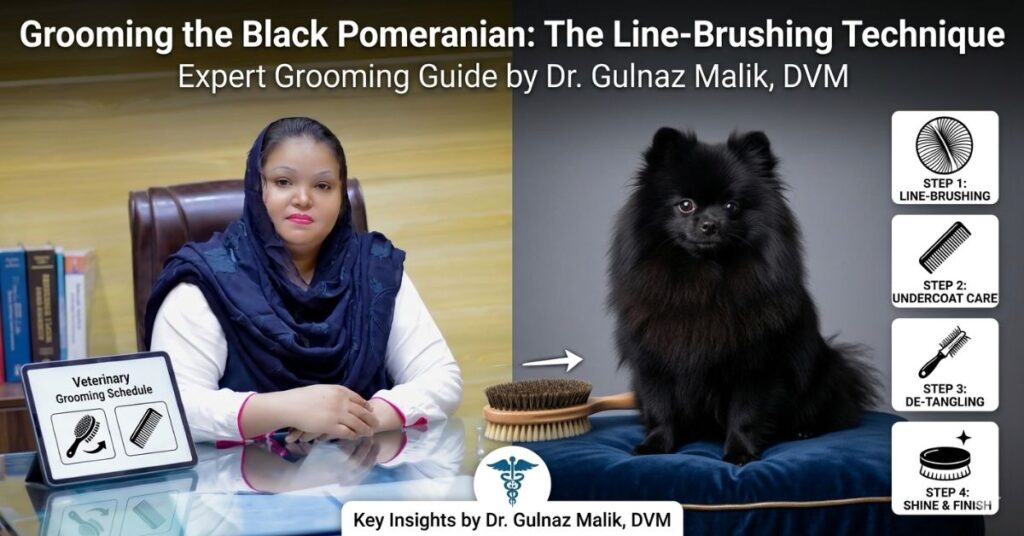
The Pomeranian’s double coat demands more structured grooming than most toy breeds. The undercoat, a dense, cotton-like layer that sits close to the skin, traps loose fur, dander, and moisture.
The outer coat consists of longer, coarser guard hairs that protect the undercoat from environmental debris. On a black Pom, any matting or dander buildup shows immediately against the dark background, making regular maintenance both a health and aesthetic priority.
Black Pomeranian Line Brushing| Step-by-Step
Line brushing is the gold standard technique for double-coated breeds. It works from the skin outward rather than brushing over the surface, ensuring you reach and release trapped undercoat without breaking guard hairs.
- Part the fur with your non-dominant hand to expose a thin horizontal “line” of skin.
- Hold a slicker brush at a 45-degree angle and brush the exposed section downward and outward, following the direction of natural coat growth.
- Move the part line upward by half an inch and repeat, overlapping each section slightly.
- Work in columns from the hindquarters forward, finishing with the chest ruff and tail.
- Finish with a wide-tooth metal comb to check for any remaining tangles at the skin level.
- On a black coat, use a dark-bristle brush (not a white-bristled one) to avoid leaving visible bristle residue.
Recommended Grooming for Black Pomeranians
| Grooming Task | Frequency | Tools Required |
|---|---|---|
| Line brushing | 3–4x per week (daily during seasonal shed) | Slicker brush, metal comb |
| Bath | Every 3–4 weeks | Dark coat shampoo, hydrating conditioner |
| Blow-dry and fluff | After every bath | Low-heat dryer, pin brush |
| Nail trim | Every 3–4 weeks | Dog nail clippers or a grinder |
| Ear cleaning | Weekly | Veterinary ear cleaner, cotton pads |
| Teeth brushing | Daily (minimum 3x per week) | Dog enzymatic toothpaste |
| Professional groom/trim | Every 6–8 weeks | Professional groomer |
Black Pomeranian Temperament| What to Expect from This Tiny Powerhouse
The color of a Pomeranian’s coat does not influence its temperament; genetics, early socialization, and training environment do. What you can expect from any well-bred Pom, regardless of color, is a dog that is alert, curious, vocal, and deeply attached to its primary person.
Black Pomeranians carry the same spirited personality as their orange counterparts. They learn quickly, respond enthusiastically to positive reinforcement, and often develop impressive trick repertoires. They also carry a notorious Napoleon complex; many black Poms will challenge dogs three times their size with the confidence of a dog that weighs thirty pounds.
Black Pomeranian Personality Traits
| Trait | Rating (1–5) | Notes |
|---|---|---|
| Intelligence | 5/5 | Exceptionally quick learners; bored easily without stimulation |
| Affection with Family | 5/5 | Bond intensely with one or two primary people |
| Barking Tendency | 4/5 | Alert barkers; early training essential |
| Adaptability | 4/5 | Thrives in apartments if exercised adequately |
| Good with Children | 3/5 | Better with older, gentle children due to fragile size |
| Good with Other Dogs | 3/5 | Socialization from puppyhood is critical |
| Trainability | 4/5 | Eager to please but can be stubborn; short sessions work best |
Black Pomeranian Health| Lifespan, Common Conditions, and Prevention
A well-cared-for Pomeranian lives 12–16 years, making it one of the longer-lived toy breeds. The black Pom shares the same health vulnerabilities as all Pomeranians, with a few additional considerations tied specifically to coat genetics.
Top Health Concerns for Black Pomeranians
| Condition | Description | Prevention / Management |
|---|---|---|
| Tracheal Collapse | Weakening of tracheal cartilage rings causes a honking cough | Use a harness (never a collar); maintain a healthy weight |
| Patellar Luxation | Kneecap slips out of the groove; causes skipping gait | Regular vet checks; surgical repair if Grade III or IV |
| Alopecia X (Black Skin Disease) | Progressive coat loss is common in Spitz breeds; more visible on dark coats | Spaying/neutering often helps; melatonin supplementation shows promise |
| Dental Disease | Small jaw creates crowded teeth; high tartar buildup | Daily brushing; annual professional dental cleaning |
| Hypoglycemia | Low blood sugar is common in toy puppies under 6 months | Feed small meals 4x daily; keep Karo syrup on hand |
| Reverse Sneezing | Rapid inhalation episodes; alarming but usually harmless | Cataracts, dry eye, and entropion are seen in the breed |
| Eye Conditions | Cataracts, dry eye, and entropion seen in the breed | Annual ophthalmic exam; monitor for discharge or squinting |
Alopecia X: A Special Concern for Black Pomeranians
Alopecia X, also called Black Skin Disease (BSD) or Coat Funk, disproportionately affects Nordic and Spitz breeds, including Pomeranians. The condition causes progressive, symmetrical hair loss beginning on the trunk, leaving the head and limbs relatively unaffected. The exposed skin darkens, hence the “black skin” descriptor, and the remaining coat loses its lustrous quality.
In black Pomeranians, Alopecia X can initially masquerade as normal seasonal shedding. Watch for a coat that fails to regrow fully after a seasonal blow, a dull and dry remaining coat, and skin that appears hyperpigmented. Neutering or spaying often triggers full coat regrowth in intact dogs, making it a first-line intervention.
Black Pomeranian Price in 2026|What You Should Expect to Pay
The black Pomeranian commands a premium over common colors like orange or cream because of its relative rarity. Reputable breeders produce fewer solid black puppies per litter than they do sable or orange, and the demand from informed buyers who understand the genetic rarity keeps prices elevated.
| Source Type | Price Range (USD, 2026) | What You Get |
|---|---|---|
| Reputable AKC Breeder (Show Quality) | $3,000 – $6,500 | Health-tested parents, genetic screening, breeder support, AKC papers |
| Reputable Breeder (Pet Quality) | $1,800 – $3,500 | Healthy puppy, basic health guarantees, limited registration |
| Teacup Black Pomeranian | $4,000 – $10,000+ | Higher price; significantly higher health risks — approach with caution |
| Rescue / Shelter Adoption | $50 – $500 | Adult dogs available; consider fostering to adopt |
| Backyard Breeder / Puppy Mill | $500 – $1,500 | Lower upfront cost; very high long-term veterinary expense |
A note on Teacup Pomeranians: The “Teacup” label is not an AKC-recognized classification. It describes dogs bred below the standard weight range (under 3 lbs), which significantly increases their risk of hypoglycemia, collapsed trachea, fragile bones, and heart defects.
The premium price does not reflect superior quality; it reflects extraordinary demand for a dog that faces extraordinary health challenges.
Black Pomeranian vs. Blue Pomeranian|Understanding the Difference
A common point of confusion involves the “blue” Pomeranian, which appears dark charcoal or grey-blue rather than true black. The blue color results from the dilute gene (d locus), which dilutes black eumelanin into a softer grey-blue. A dog that carries two copies of the recessive dilute allele (d/d) will express blue rather than black.
| Feature | Black Pomeranian | Blue Pomeranian |
|---|---|---|
| Coat Color | Rich, uniform jet black | Charcoal grey with blue undertone |
| Underlying Gene | Non-dilute (D/D or D/d) | Dilute (d/d) |
| Nose Color | Solid black | Blue-grey (slate) |
| Eye Color | Dark brown to black | Lighter brown, sometimes amber |
| Coat in Sunlight | Remains black; may show blue sheen | Appears grey-blue; lightens toward the face |
| Health Consideration | Standard Pom concerns | Higher risk of Color Dilution Alopecia (CDA) |
| Rarity / Price | Rare; premium priced | Very rare; higher premium |
About the Author
Dr. Gulnaz Malik, DVM, MSc Animal Nutrition, brings over a decade of clinical veterinary experience to her writing, specializing in the unique health and nutritional requirements of toy breeds. As the founder of Chihuahua Nest, she has dedicated her career to educating owners on canine longevity and breed-specific care. Dr. Malik’s insights combine rigorous scientific research with her first-hand experience managing the complex health needs of Spitz-type dogs.
Conclusion
The black Pomeranian is not a novelty. It is a rare, genetically specific expression of one of the world’s most charismatic toy breeds, and it demands the same informed, committed ownership that any Pomeranian requires, plus a few additional considerations unique to the dark coat.
You need to understand heat management, invest in coat care beyond surface brushing, monitor for Alopecia X, and source your puppy from a breeder who conducts genetic and health testing. In return, you get a dog that combines the bold personality of a much larger animal with a coat that turns sunlight into pure elegance.
Do your research. Choose a reputable breeder. Schedule regular veterinary check-ups. Master the line-brushing technique. Protect that coat from the sun. If you commit to those fundamentals, the black Pomeranian will reward you with a decade and a half of unforgettable companionship.
Questions
Q1: Do black Pomeranians change color as they grow up?
Yes, and this surprises many first-time owners. Pomeranians undergo a phase called the “puppy uglies” between 3 and 6 months of age, during which they shed their puppy coat and grow in their adult coat. A true, solid black Pom will retain its dark color through this transition, though it may appear moth-eaten or patchy temporarily.
Dark sable Poms, however, often lighten significantly during this phase, revealing gold or cream undertones in the adult coat. The Sun Test described earlier helps identify true blacks before you commit to a purchase.
Q2: Are black Pomeranians recognized by the AKC?
Yes. The AKC fully recognizes solid black as a standard color in the Pomeranian breed standard. A black Pom with AKC registration can compete in conformation shows, obedience trials, and all AKC performance events.
The coat must be fully black with no white chest patches or tan points; any secondary color disqualifies the dog from the “solid black” classification in the show ring.
Q3: Do black Pomeranians shed more than other colors?
No shedding frequency and volume relate to the double coat structure, not coat color. All Pomeranians shed moderately throughout the year and undergo two heavy seasonal “coat blows” (typically in spring and fall) during which they lose enormous quantities of undercoat.
The difference for black Poms is that dark fur shows more visibly on light-colored furniture and clothing. Regular line brushing significantly reduces the amount of loose fur that reaches your upholstery.
Q4: What health problems are unique to black Pomeranians?
Black Pomeranians share most health concerns with all Pomeranians. The one condition with a higher visible impact on black-coated dogs is Alopecia X (Black Skin Disease), which causes progressive coat loss and skin darkening.
The black coat also absorbs more UV radiation, making sun-related coat bleaching and overheating higher risks than for lighter-coated dogs. No conditions are caused exclusively by the black coat, but the color intensifies the visibility and the thermal impact of several common issues.
Q5: Can I breed two black Pomeranians to always get black puppies?
If both parents carry homozygous dominant alleles at the relevant loci (E/E and a/a), then yes, all offspring will be solid black. However, if either parent carries a recessive “e” allele (making them E/e), approximately 25% of puppies from that pairing may express non-black phenotypes.
Genetic testing of breeding dogs through a reputable canine DNA laboratory lets you predict color outcomes with accuracy rather than guessing.
Q6: How do I prevent my black Pomeranian’s coat from turning rust-colored?
The most effective combined approach involves: feeding a diet rich in omega-3 fatty acids (EPA+DHA from fish oil), supplementing L-tyrosine and chelated zinc under veterinary guidance, limiting peak-sun outdoor exposure, applying a UV-protective coat spray before outdoor activities, using a colour-enhancing dark-coat shampoo monthly, and addressing saliva staining from paw-licking by treating the underlying cause (allergies, anxiety, or boredom).