

Quick Answer
The best battery-operated hair clippers for dogs should combine strong cutting power, long battery life, low noise, comfortable handling, and blades that stay cool.
For most home groomers, a quality cordless clipper such as the Wahl Bravura offers a useful balance of quiet operation and flexibility, while the Andis Pulse ZR II is better suited for heavier professional grooming.
Author Box
Author: Gulnaz Malik
Role: Publisher & Pet Care Expert
Experience: 5+ Years in Dog Care & Dog Grooming
Content Review: Veterinary-reviewed content approach based on trusted canine care resources and practical pet care experience.
Introduction
The best battery-operated hair clippers can make dog grooming much easier by removing the restriction of a power cord.
You can move around your dog, change positions, and reach difficult areas without worrying about a cable getting under your feet.
However, not every cordless clipper works equally well on dog hair. A model designed for light trimming may struggle with thick, curly, tangled, or matted coats.
A weak motor can pull hair instead of cutting it cleanly. A poor battery can also die halfway through grooming.
Choosing the right clipper depends on your dog’s coat, grooming frequency, size, temperament, and the amount of hair you need to remove.
This guide focuses on battery-powered dog grooming clippers, not ordinary human hair clippers. That distinction matters because dog coats can be much denser than human hair.
You will learn which features matter most, how cordless clippers compare with corded models, which options suit different coat types, and how to use a battery-operated clipper safely.
Routine grooming also gives you a chance to examine your dog’s coat, skin, ears, paws, and nails. The American Kennel Club recommends choosing grooming equipment according to the dog’s breed, coat texture, and coat length.
What Makes the Best Battery-Operated Hair Clippers Good for Dogs?
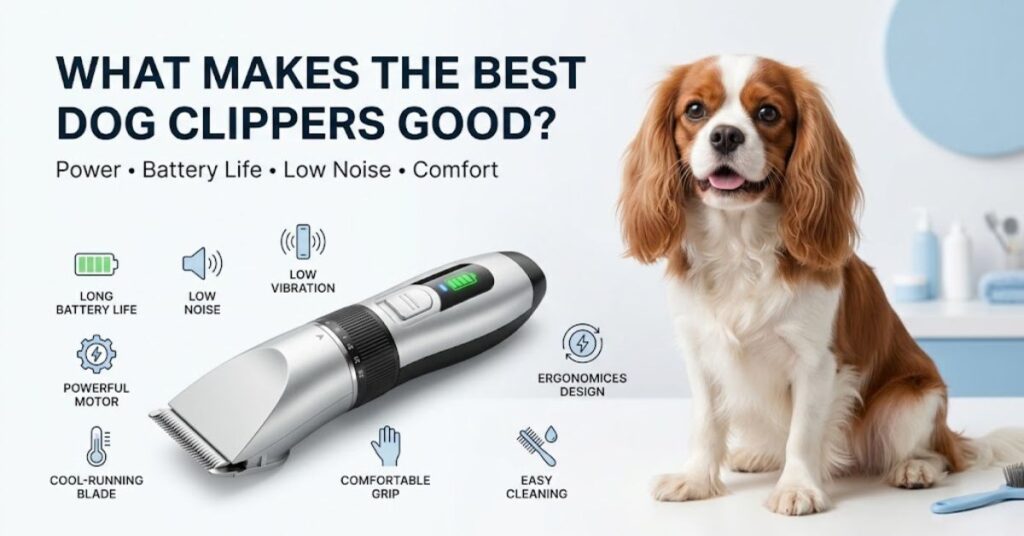
The best battery-operated hair clippers should do more than simply run without a cord. They need enough motor power to move through the dog’s coat smoothly while giving you good control.
Battery performance is one of the first things to check. A clipper with a long runtime gives you enough time to finish a grooming session without stopping to recharge.
Lithium-ion batteries are especially useful because many modern cordless grooming tools can provide substantial runtime while remaining relatively lightweight.
Motor strength also matters. Thick coats, curly coats, and long hair create more resistance than short, fine fur.
A weak motor may slow down when you move through dense areas. Stronger professional models usually maintain more consistent cutting performance.
Noise and vibration deserve equal attention. Some dogs become nervous when they hear a loud buzzing sound near their body. A quieter clipper can make training and grooming easier, especially for puppies and anxious dogs.
Blade quality affects both the finish and your dog’s comfort. Sharp blades cut more efficiently. Dull or dirty blades can pull hair and create additional friction.
Heat is another important safety issue. Blades can become warm during extended grooming. Always check the blade with your hand before placing it against sensitive skin. If it feels too hot for your hand, give it time to cool.
Ergonomics matter too. A heavy clipper can become uncomfortable during a long grooming session. A lightweight cordless design gives you more freedom to reposition your hand.
For additional background on choosing grooming equipment, see our guide to Best Dog Clippers for 2026.
A good cordless clipper should therefore balance power, battery runtime, noise, blade performance, heat control, and handling comfort rather than focusing on one specification.
Best Battery-Operated Hair Clippers for Different Coat Types
There is no single cordless clipper that works perfectly for every dog. Coat texture should guide your purchase.
Small dogs with fine or moderately long hair usually do not need the same cutting power as large dogs with dense coats. A lightweight clipper may provide better control for a Chihuahua, Yorkie, Maltese, or similar companion breed.
Curly coats require good blade movement because curls can resist ordinary cutting. Poodles and Poodle mixes often need stronger equipment and regular brushing before clipping.
Thick coats present another challenge. Dense hair can quickly expose weak motors and dull blades. Professional-grade cordless clippers are usually a better choice when you groom thick coats frequently.
Matted fur requires special caution. Do not simply force a clipper through severe mats. Mats can pull the skin and hide irritated or damaged areas underneath. Professional grooming may be safer when mats are tight against the skin.
Quick Coat-Matching Framework
Use this simple Coat-to-Clipper Match before buying:
- Fine, short coat: lightweight cordless clipper
- Medium coat: adjustable-blade cordless clipper
- Long silky coat: quiet clipper plus thorough brushing
- Curly coat: strong motor and sharp blade
- Thick coat: professional heavy-duty cordless model
- Matted coat: professional assessment before clipping
- Face and paw detail: small, precise trimmer
| Coat Type | Clipper Priority | Recommended Approach | Home Grooming Level |
| Fine/short | Quiet, lightweight | Regular maintenance trims | Beginner |
| Long/silky | Low vibration, precise blade | Brush thoroughly first | Beginner–Intermediate |
| Curly | Strong motor, sharp blade | Remove tangles before clipping | Intermediate |
| Thick/dense | High-power, durable blade | Work in small sections | Intermediate–Professional |
| Matted | Heavy-duty equipment | Professional help may be needed | Professional |
| Face/paws | Small precision tool | Use slow, controlled movements | Intermediate |
One important point: a cordless clipper does not replace brushing. The American Kennel Club recommends regular brushing based on coat type because brushing removes debris, helps prevent mats, and lets owners inspect the skin.
If you regularly groom breeds with demanding coats, our Best Barber Clippers and Trimmers for Dogs guide provides additional options.
Best Battery-Operated Hair Clippers: Top Choices for 2026
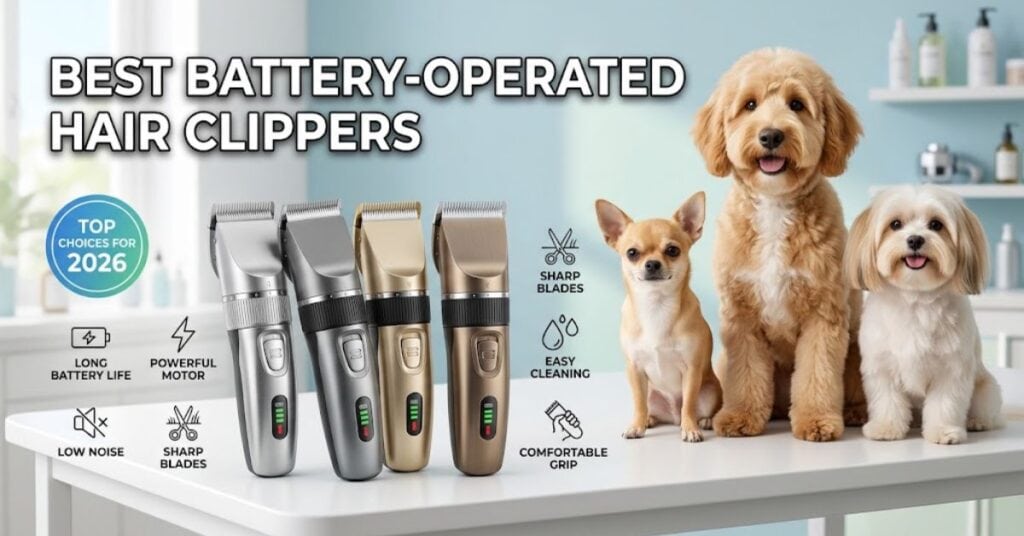
Several cordless models stand out because they address different grooming needs.
Wahl Bravura Lithium-Ion is a strong choice for owners who want a lightweight, quiet clipper for small and medium dogs.
It is particularly useful for detailed grooming and routine maintenance. Existing ChihuahuaNest research also identifies the Bravura as a quiet cordless option for small dogs.
Andis Pulse ZR II is better suited to demanding grooming. Its professional design makes it useful when you need more power and flexibility for longer grooming sessions.
Wahl Arco Cordless is another practical choice for home grooming and lighter trimming. Its compact design can be useful when handling smaller dogs.
Oneisall cordless dog clippers can appeal to beginners who want an affordable grooming setup with multiple accessories.
However, budget models are generally better for light-duty grooming than for demanding professional work.
Heiniger Opal is a premium cordless option aimed at users who want professional performance and quiet operation.
Current grooming comparisons continue to highlight cordless models from Wahl, Andis, and other established grooming brands.
Professional and consumer reviews also show that battery life, motor consistency, blade quality, and ergonomics matter more than simply choosing the cheapest cordless tool.
For owners who want a broader comparison, our Best Rated Dog Clippers guide covers corded and cordless choices.
How I Would Match Them
- Small dog/home grooming: Wahl Bravura
- Quiet grooming: Wahl Bravura or Heiniger Opal
- Professional cordless grooming: Andis Pulse ZR II
- Light trimming: Wahl Arco
- Budget home grooming: oneisall
- Heavy professional work: Andis Pulse ZR II or another professional-grade model
Remember that product specifications can vary by version, market, and package. Check the manufacturer’s current specifications before purchasing.
Battery Life, Motor Power, and Blade Performance Matter Most
When shopping for the best battery-operated hair clippers, do not judge performance by battery runtime alone.
A clipper may advertise impressive battery life but still struggle with dense hair. Conversely, a powerful professional clipper may use more energy because its motor is designed for demanding grooming.
A useful target for home grooming is enough runtime to comfortably finish your dog’s normal session with some reserve. If your dog takes 30–45 minutes to groom, a clipper offering substantially more runtime gives you a safer margin.
Battery indicators are also useful. A visible battery display lets you know when charging is necessary. This prevents the frustrating situation of starting a grooming session with an almost-empty battery.
Fast charging can help, but it should not be your only consideration. A short charging time is useful when you forget to charge the clipper, but good overall runtime is more important for routine grooming.
Motor consistency matters when cutting dense hair. As the battery drains, some low-quality cordless clippers may lose cutting performance. Better models are designed to maintain useful power for much of the charge.
Blade design matters just as much. Detachable blades allow faster changes and easier maintenance. Adjustable blades can make one clipper more versatile.
Ceramic blades can help with heat management, while stainless-steel blades offer durability. The exact blade material matters less than sharpness, maintenance, and compatibility with the clipper.
Never continue clipping if the blade becomes excessively hot. Hot equipment can hurt your dog.
Clean the blade after every grooming session. Hair and debris create friction and can reduce cutting performance. Regular oiling also helps maintain smooth blade movement.
For professional groomers, keeping a second charged battery or backup clipper can prevent interruptions during long grooming days.
How to Use Battery-Operated Hair Clippers Safely
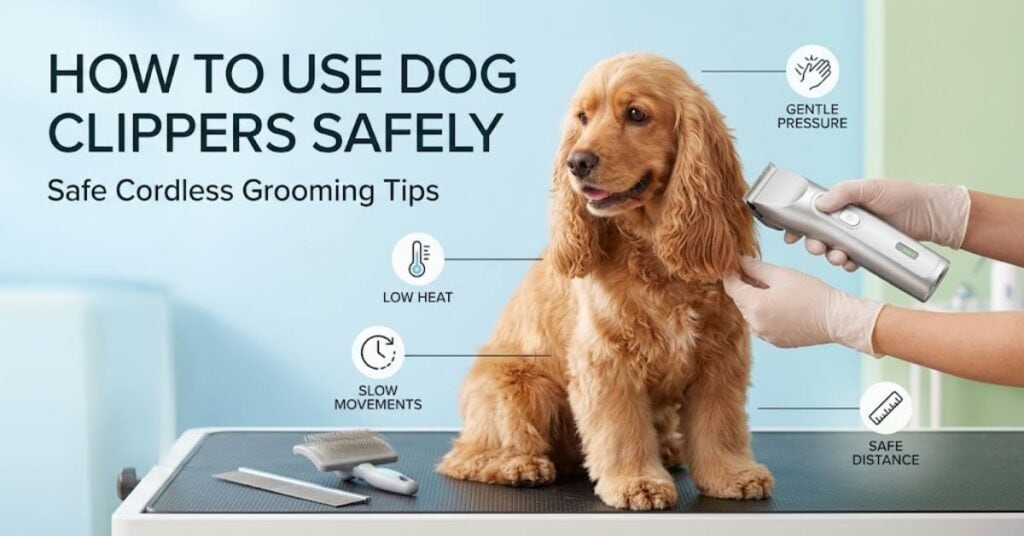
Cordless grooming removes the power cord, but it does not remove the need for careful technique.
Before turning the clipper on, brush your dog thoroughly. Work through tangles and identify mats. Never assume that a clipper can safely power through every knot.
Let your dog hear the clipper before putting it against the coat. Turn it on several feet away and reward calm behavior. Move it closer gradually.
Start with a longer guard or a safer cutting length. You can always shorten the coat later, but removing too much hair cannot be reversed immediately.
Keep your movements slow and controlled. Avoid repeatedly passing over the same patch of skin.
Pay extra attention around the face, ears, armpits, groin, and paw pads. These areas contain folds, loose skin, and sensitive structures that increase the chance of accidental injury.
Never force the blade through a tight mat. If the coat is severely matted, professional grooming is the safer option.
The AKC specifically advises owners not to attempt hair clipping or shaving without proper training, particularly when sensitive areas are involved. Professional groomers have the equipment and experience to handle these areas more safely.
My 5-Step Cordless Grooming Safety Method
1. Prepare
Brush the coat, gather equipment, charge the clipper, and choose a calm location.
2. Introduce
Allow your dog to smell and hear the clipper before trimming.
3. Start Long
Begin with a longer guard so you can assess the coat and your technique.
4. Check Heat
Stop regularly and touch the blade carefully. Change or cool it if necessary.
5. Monitor Behavior
Stop if your dog shows strong fear, pain, struggling, or unusual distress.
Do not groom over open wounds, irritated skin, infections, or unexplained lumps. Ask your veterinarian for advice when you notice a medical problem during grooming.
Cordless vs. Corded Dog Clippers: Which Is Better?
Cordless clippers offer freedom of movement. That advantage becomes obvious when grooming a dog that moves around the table or needs frequent repositioning.
You can move from one side of the dog to the other without dragging a cord behind you. This can make grooming feel more comfortable and organized.
Corded clippers still have an important place. Professional groomers who work on several dogs may prefer continuous electrical power. A corded model does not depend on battery capacity during a long grooming session.
Corded tools can also be attractive for very dense coats where consistent power matters.
Cordless models have improved considerably, though. Modern professional options can provide substantial runtime and strong motor performance. Current 2026 comparisons include cordless models designed specifically for professional grooming workloads.
The right choice depends on your situation.
| Feature | Battery-Operated Clippers | Corded Clippers |
| Movement | Excellent | Limited by cord |
| Charging | Required | Not required |
| Long sessions | Battery dependent | Excellent |
| Home use | Very convenient | Good |
| Professional use | Excellent with backup | Excellent |
| Noise | Depends on model | Depends on model |
| Maintenance | Battery + blade care | Blade + cable care |
| Best advantage | Freedom of movement | Continuous power |
For most occasional home groomers, cordless equipment is convenient. For professional grooming or very dense coats, keeping a corded backup can be a smart strategy.
The best setup may actually include both. Use the cordless clipper for mobility and detail work, while keeping the corded unit available when the coat demands sustained power.
Common Mistakes When Buying and Using Cordless Dog Clippers
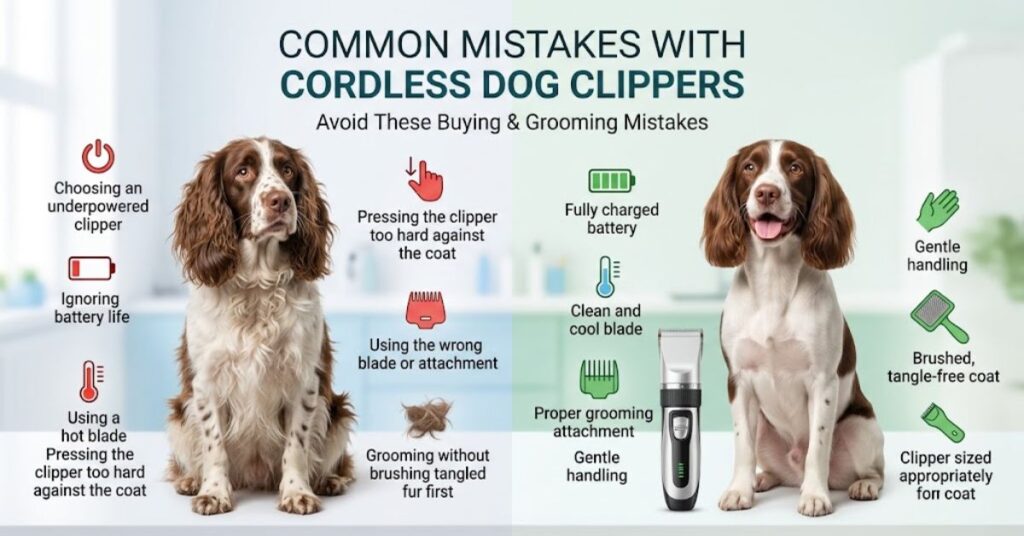
Many grooming problems start before the first haircut.One common mistake is buying a clipper based only on price. Cheap equipment may look attractive, but weak motors, poor batteries, or low-quality blades can make grooming harder.
Another mistake is choosing a human hair clipper because it looks similar to a dog clipper. Dog coats can require different cutting performance and grooming accessories. Choose equipment specifically designed for animals whenever possible.
Ignoring coat type creates another problem. A lightweight clipper that works beautifully on a small, silky-coated dog may struggle badly on a large dog with thick fur.
Owners also sometimes ignore noise. If your dog already dislikes grooming, a loud vibrating tool can make training harder.
Skipping maintenance is equally damaging. Hair buildup and inadequate blade lubrication can increase friction and heat.
Do not assume that longer battery life automatically means better performance. Motor strength, blade quality, charging system, ergonomics, and heat management all matter.
Battery Clipper Do’s and Don’ts
Do:
- Charge the clipper before grooming.
- Brush and detangle the coat first.
- Start with a longer cutting length.
- Keep blades clean and lubricated.
- Check blade temperature regularly.
- Give nervous dogs breaks.
- Use dog-specific grooming equipment.
- Keep a backup option for long sessions.
Don’t:
- Force a clipper through severe mats.
- Ignore excessive blade heat.
- Shave sensitive areas without training.
- Continue if your dog is panicking.
- Use damaged blades.
- Groom over wounds or irritated skin.
- Assume every cordless model works on every coat.
- Skip professional help when the coat is severely tangled.
The FDA notes that grooming aids such as unmedicated dog shampoos fall into the broader category of animal grooming products, while veterinary medical concerns remain under veterinary oversight.
For health problems discovered during grooming, consult your veterinarian rather than attempting to treat the problem with grooming equipment.
How to Maintain Battery-Operated Hair Clippers
Proper maintenance can make your cordless clipper perform better for longer.
Start by removing loose hair after every session. Use the cleaning brush supplied with the clipper or another manufacturer-approved method.
Oil the blade according to the manufacturer’s instructions. Lubrication reduces friction and helps the blade move smoothly.
Never store the clipper covered in wet hair or moisture. Dry equipment should remain in a clean, protected location.
Battery care matters too. Follow the manufacturer’s charging instructions instead of leaving the clipper connected indefinitely if the manufacturer advises otherwise.
Inspect the blade regularly. If it becomes dull, damaged, or unusually rough during cutting, replace or service it.
Weekly Cordless Clipper Care Schedule
After every grooming session
- Remove hair from the blade.
- Clean the clipper.
- Oil the blade as directed.
- Check for damage.
Weekly
- Inspect the blade attachment.
- Check guards for cracks.
- Clean difficult-to-reach areas.
- Confirm charging equipment works properly.
Monthly
- Check battery performance.
- Look for unusual heat or vibration.
- Inspect screws and attachments.
- Replace damaged accessories.
A maintenance routine prevents small problems from becoming expensive repairs.
If your clipper suddenly starts pulling hair, making an unusual noise, overheating quickly, or losing cutting power, stop using it until you identify the cause.
FAQs
Are battery-operated hair clippers good for dogs?
Yes. Cordless dog clippers are convenient, easy to handle, and ideal for many home grooming tasks.
What are the best cordless clippers for small dogs?
Lightweight models like the Wahl Bravura are popular for small dogs because they offer good control and low noise.
Can cordless clippers cut thick dog hair?
Yes, if they have a strong motor and a sharp blade. Thick or matted coats may need professional grooming.
How long do cordless dog clippers last on one charge?
Battery life varies by model. Choose a clipper with enough runtime to complete your dog’s grooming session comfortably.
Are cordless or corded clippers better for dogs?
Cordless clippers offer better mobility, while corded models provide continuous power for long grooming sessions.
Conclusion
The best battery-operated hair clippers can turn home dog grooming into a more flexible and comfortable routine. Without a power cord, you can move around your dog more easily and reach awkward areas without managing a cable.
However, convenience should never be the only buying factor. Motor strength, battery runtime, blade quality, noise, vibration, heat control, and ergonomics all affect the grooming experience.
For small and medium dogs, a lightweight cordless model such as the Wahl Bravura can be a practical starting point. More demanding grooming may require a professional model such as the Andis Pulse ZR II. Budget cordless clippers can work for light maintenance, but they may not be appropriate for dense or matted coats.
Most importantly, choose your clipper according to your dog’s coat rather than the product’s appearance or price. Brush and detangle the coat before clipping, introduce the clipper gradually, monitor blade temperature, and stop when your dog becomes highly stressed.
Regular grooming should improve your dog’s comfort rather than become a struggle. If you are unsure about clipping sensitive areas or dealing with severe mats, a professional groomer is the safer choice.
With the right cordless equipment, patience, and maintenance routine, many owners can handle basic grooming safely at home.
Multimedia Placement Suggestions
- Featured Image: Cordless dog clipper beside a freshly groomed small dog.
- Grooming Flowchart: “Brush → Check Mats → Charge Clipper → Introduce Noise → Trim → Check Blade Heat.”
- Comparison Graphic: Cordless vs. corded dog clippers.
- Before & After Image: Dog with an overgrown coat compared with a neatly trimmed coat.
- YouTube Thumbnail: “How to Safely Use Cordless Dog Clippers at Home.”
- Pinterest Image: “Best Battery-Operated Hair Clippers for Dogs 2026 Buying Guide.”
Tags
best battery-operated hair clippers, cordless dog clippers, best cordless dog clippers, dog grooming clippers, rechargeable dog clippers, quiet dog clippers, dog grooming tools, cordless pet clippers, dog grooming at home, professional dog clippers
Social Media Caption
Looking for the best battery-operated hair clippers for dogs? 🐶✂️ Learn which cordless clippers work best for different coat types, what features matter, and how to groom your dog safely at home. #DogGrooming #DogClippers #CordlessClippers #PetCare #DogCare #ChihuahuaNest
Sources Used for Research
Primary Keywords:
- best battery-operated hair clippers
- best cordless dog clippers
- battery-operated dog grooming clippers
Secondary Keywords:
- cordless dog grooming clippers
- quiet dog clippers
- dog clippers for thick coats
- rechargeable dog clippers
- professional cordless dog clippers
Related Keywords:
cordless pet clippers, lithium-ion dog clippers, low-noise clippers, ceramic blades, detachable blades, adjustable blade, dog grooming tools, clipper battery life, clipper overheating, matted dog hair, small dog grooming, home dog grooming, puppy grooming, clipper maintenance, grooming safety